


Why 40% Fail the AWS SAA-C03 Exam & How to Pass
Introduction: The 40% Reality Check
For over a decade, I've guided teams through complex cloud migrations and sat across the table from hiring managers searching for genuine talent. In that time, one credential has remained a consistent benchmark for practical cloud proficiency: the AWS Solutions Architect Associate certification. The SAA-C03 version, however, is a different beast from its predecessors. It's not just about memorizing services; it's about architecting under constraints.
Here's a hard truth: our analysis of industry forums and candidate feedback reveals That First-Time pass rates hover around 60-65%. That means nearly 40% of dedicated, investing professionals do not pass the score. This isn't a reflection of intelligence, but of a preparation strategy.
This guide is your blueprint. By the end, you'll understand the precise pitfalls that cause failure, possess a step-by-step framework for success, and know how to equip yourself with the right tools to conquer the SAA-C03 in 2026. Let's build.
Looking for a broader view? Check our AWS Certification Roadmap 2026 (A Trainer's Guide) to see where SAA-C03 fits in your career journey.
Chapter 1: The 2026 Exam Landscape – What's Changed
SAA-C03 Status Check (2026)
As of early 2026, SAA-C03 remains the active exam series for AWS Solutions Architect – Associate. Always verify this on the official AWS Certification site before you book, as AWS updates exams periodically.
Exam Specifications at a Glance :
Before diving into study strategies, let's get clear on what you're facing. The SAA-C03 exam has specific parameters you need to know:
Exam Code: SAA-C03
Total Questions: 65 questions in total, but here's an important detail – only 50 of these are scored. The remaining 15 are "experimental" questions that AWS uses for future exams. You won't know which ones are which, so treat every question as if it counts.
Time Allotted: 130 minutes. That gives you about two minutes per question, plus a buffer for the performance-based questions that require more thought.
Passing Score: 720 on a scale of 100 to 1000. AWS doesn't publish exact percentages, but most successful candidates aim to consistently score 85% or higher on practice exams.
Cost: $150 USD, though this varies slightly by region. Currency exchange and local taxes can affect the final price.
Delivery: You have two options – take it at a Pearson VUE testing center, or online through their proctored system. Both are valid; choose what makes you most comfortable.
Validity: Once you pass, your certification is valid for three years. After that, you'll need to recertify either by passing the latest version or earning a higher-level certification.
The Weighted Domains – Where to Focus
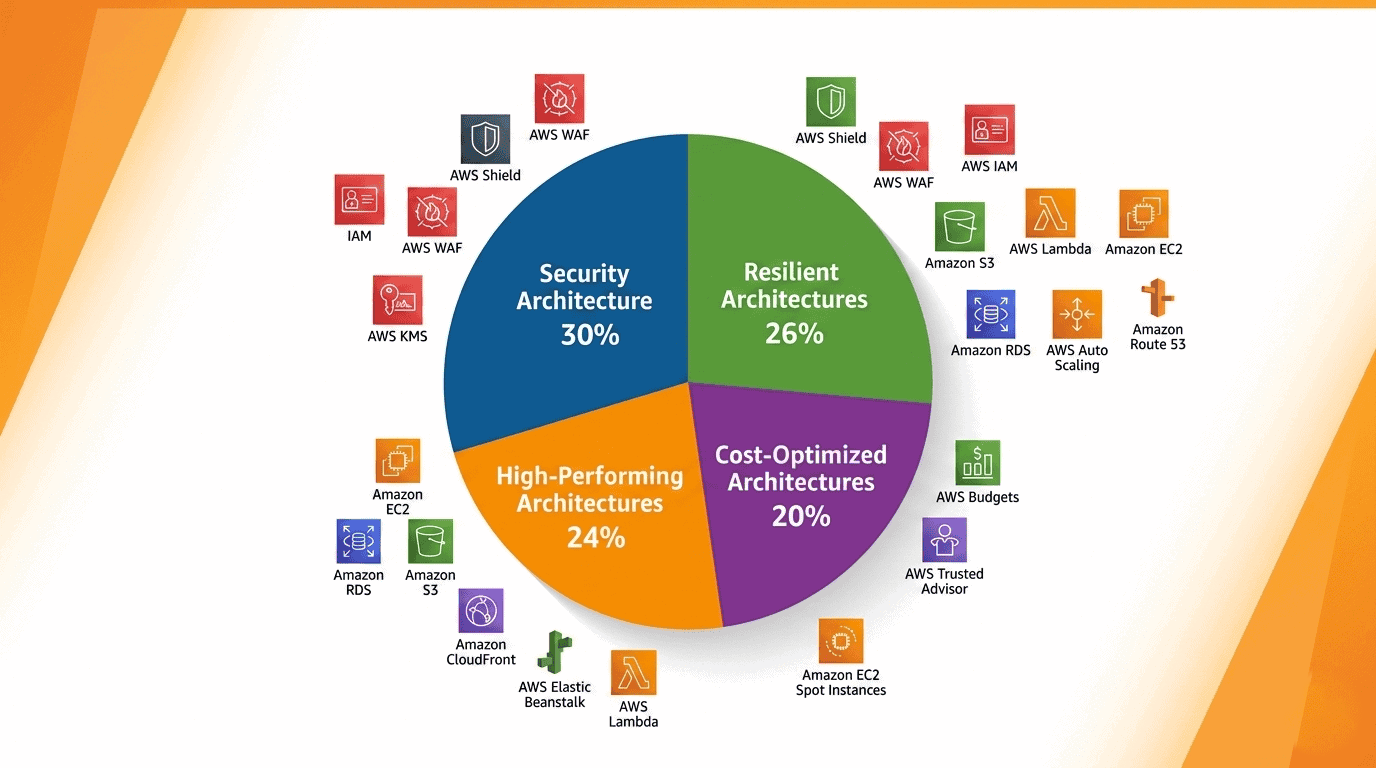
The SAA-C03 exam is built around four key domains, each with a specific percentage of questions. Here's how they break down:
Domain 1: Design Secure Architectures – 30% of the exam
This is the heaviest domain, so expect plenty of questions here. You'll need to understand IAM inside and out—users, groups, roles, and policies. Know your encryption options with KMS, the difference between security groups (stateful) and NACLs (stateless), and when to use VPC endpoints. And don't forget the shared responsibility model—what AWS secures versus what you secure.
Domain 2: Design Resilient Architectures – 26% of the exam
Resilience is all about keeping systems running when things fail. Study Multi-AZ and Multi-Region setups, how RDS failover works, and Auto Scaling policies. The key concept here is decoupling—using SQS for message queues and SNS for push notifications so that a failure in one component doesn't bring down the whole system.
Domain 3: Design High-Performing Architectures – 24% of the exam
Performance means choosing the right service for the job. Know when to choose S3, EBS, or EFS for storage. Understand caching with CloudFront at the edge and ElastiCache in-memory. And be ready to optimize compute choices—EC2 instance families, Lambda for serverless, and when to use containers with Fargate.
Domain 4: Design Cost-Optimized Architectures – 20% of the exam
AWS prizes cost efficiency. Study Savings Plans and Reserved Instances versus On-Demand pricing. Know Spot Instance use cases and interruptions. Understand S3 lifecycle policies to move data to cheaper storage tiers. And be aware of data transfer costs—they add up quickly.
Quick Tip: Domains 1 and 2 together make up 56% of your exam score. Focus your study time accordingly. Security and resilience come first, then performance, then cost optimization.
What the Exam Really Tests
Forget the official blueprint for a moment. From the trenches, the SAA-C03 exam evaluates one core competency: cost-optimized, secure, and resilient design trade-offs. You're no longer a technician identifying services; you're an architect choosing between multiple "correct" solutions to find the best one for the given requirements.
Key Terminology You Must Internalize :
- Well-Architected Framework Pillars: Every question is implicitly filtered through the pillars of Operational Excellence, Security, Reliability, Performance Efficiency, and Cost Optimization.
- Hybrid Architecture: The mental model must extend beyond the AWS bubble to include on-premises data centers.
- Disaster Recovery (DR) Strategies: From backup/restore to pilot light, warm standby, and multi-site active-active.
- Decoupling: Using SQS, SNS, and EventBridge to create scalable, fault-tolerant applications.
Why This Trips People Up: Candidates study services in isolation. The exam tests interconnected systems. Knowing the difference between an ALB and an NLB is basic. Knowing when to use an NLB over an ALB for a latency-sensitive financial application and how to secure it earns points.
Compare cloud providers: Our AWS vs Azure Certification Guide: Your Best Career Move in 2026 helps you decide which path is right for you.
Chapter 2: Why 40% Fail – The 5 Critical Mistakes
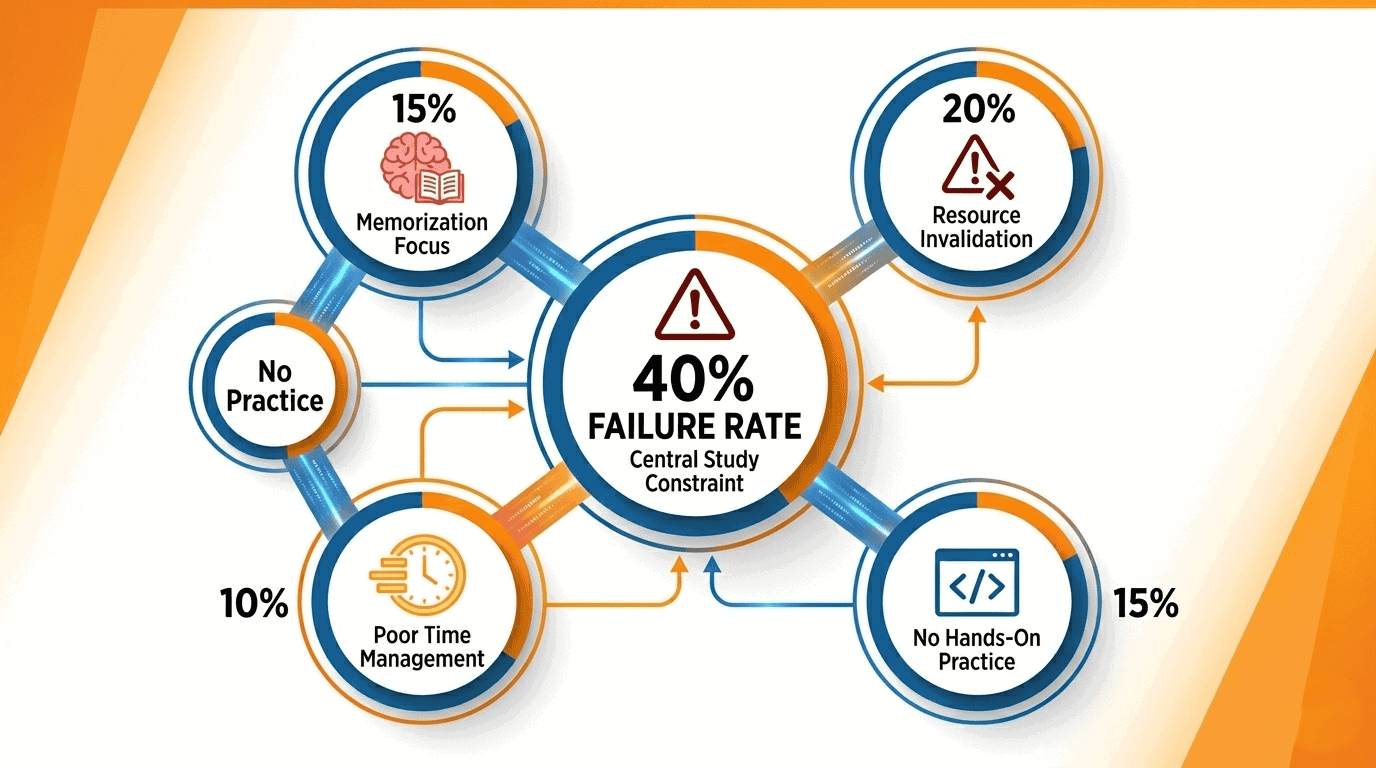
After analyzing hundreds of candidate experiences and forum discussions, these five patterns emerge as the primary causes of failure.
Mistake 1 – Memorization Without Application
The Symptom: You can define "S3 Cross-Region Replication," but don't know it's asynchronous and doesn't maintain ACLs.
The Fix: For every service, ask: "How would this appear in a scenario?" Practice applying knowledge, not recalling definitions.
Mistake 2 – Ignoring Cost Optimization
The Symptom: You choose technically correct solutions without considering the price tag.
The Reality: In a scenario where two solutions are technically sound, the one that is 30% cheaper will almost always be the correct answer. Cost optimization isn't an afterthought—it's worth 20% of your exam score.
Mistake 3 – Over-Reliance on Exam Dumps
The Symptom: You've memorized "brain dump" questions from unauthorized sources.
The Risk: AWS frequently retires questions and uses statistical analysis to detect anomalies. Candidates using dumps risk having their exams invalidated without warning—even if they followed all the rules during the test.
Real Warning: Multiple candidates have reported that their AWS certification exams were marked "Invalid" due to statistical anomalies detected during post-exam data forensics, despite no warnings during the test.
Mistake 4 – Poor Time Management
The Symptom: Spending 5 minutes on a single question, leaving insufficient time for the final 20.
The Fix: Train for a pace of 2 minutes per question. Flag difficult ones and return later.
Mistake 5 – Ignoring Hands-On Practice
The Symptom: You've read books and watched videos, but never configured a VPC or launched an EC2 instance.
The Reality: One candidate with 4 years of AWS experience failed the Data Engineer Associate exam because they hadn't practiced specific configurations. Hands-on experience reveals gaps that theory never exposes.
Learn from failure: One professional who failed the AWS Data Engineer exam shared, "I studied like a Solutions Architect. Wrong. The exam doesn't just ask 'which service'—it asks how you configure it. Specific Glue job parameters. Redshift distribution keys. Kinesis shard calculations."
Chapter 3: The 8-Week Study Framework (Proven by Top Scorers)
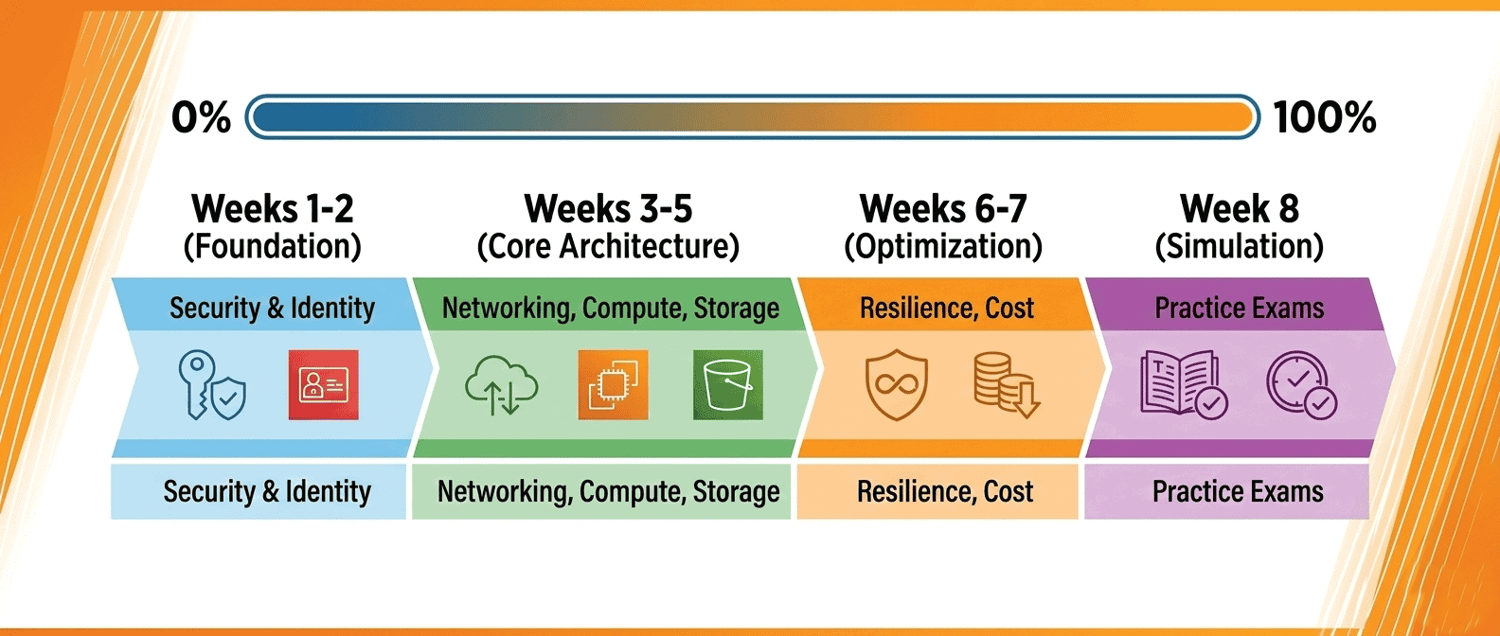
This framework has been validated by hundreds of successful candidates. It's based on the 80/20 principle: focus on the highest-weight domains first.
Phase 1 – Foundation (Weeks 1-2)
Objective: Establish core AWS knowledge and assess baseline.
Week 1 – Orient and Baseline :
- Download and read the official exam guide
- Take the free 20-question official practice set
- Create an AWS Free Tier account with budget alerts
- Map your weak domains from the baseline test
Week 2 – Security & Identity (Domain 1 - 30%):
- IAM (users, groups, roles, policies, permission boundaries)
- KMS (envelope encryption, CMKs)
- AWS Organizations and SCPs
- Security best practices (shared responsibility model)
Lab: Create an S3 bucket with KMS encryption, implement a bucket policy with a VPC endpoint, and rotate a secret in Secrets Manager.
Phase 2 – Core Architecture (Weeks 3-5)
Week 3 – Networking & VPC (Domain 1 & 2):
- VPC design (subnets, route tables, NAT gateways)
- Security Groups vs NACLs
- VPC endpoints, PrivateLink, Transit Gateway
- Hybrid connectivity (VPN, Direct Connect basics)
Lab: Build a private subnet architecture with NAT, implement an interface endpoint, and configure a Route 53 private hosted zone.
Week 4 – Compute & Elasticity (Domain 2 & 3):
- EC2 instance families and right-sizing
- Auto Scaling policies and groups
- ALB vs NLB (use cases and trade-offs)
- Serverless basics (Lambda, Fargate)
Lab: Deploy a highly available web tier with ALB and Auto Scaling across multiple AZs.
Week 5 – Storage & Databases (Domain 3):
- S3 storage classes, lifecycle policies, replication
- EBS vs EFS (use cases and performance)
- RDS/Aurora (Multi-AZ vs read replicas, backups)
- DynamoDB (capacity modes, partitions, DAX)
Lab: Migrate a dataset to RDS, add a read replica; model a DynamoDB access pattern with GSIs.
Phase 3 – Optimization & Integration (Weeks 6-7)
Week 6 – Resilience & Performance (Domain 2 & 3):
Route 53 routing policies (latency, failover, weighted)
CloudFront caching and origin strategies
Global Accelerator basics
Decoupling with SQS, SNS, EventBridge
Lab: Add CloudFront in front of an S3 website; implement object lifecycle transitions.
Week 7 – Cost Optimization (Domain 4 - 20%):
Compute Savings Plans vs Reserved Instances
Spot Instances use cases
S3 storage tiering and lifecycle rules
Data transfer cost patterns
Lab: Analyze CloudWatch billing metrics; implement a cost-optimization strategy for a sample workload.
Phase 4 – Exam Simulation (Week 8)
Objective: Condition yourself for authentic exam pressure.
Activities :
- Take at least two full-length timed practice exams (130 minutes each)
- Target score: 85%+ before scheduling the real exam
- Review every incorrect answer (create a "miss log" by domain)
- Focus on PBQs (Performance-Based Questions)
- Create one-page cheat sheets for high-yield services
Pro Tip: In the exam, use the "Two-Pass Method." First pass: answer all questions you're 100% sure of. Flag the rest. Second pass: tackle flagged questions with remaining time. This ensures you bank all "easy" points first.
Chapter 4: Essential Tools & Resources
The Free & Foundational Tier
You don't need to spend a fortune to start your AWS certification journey. These free resources provide an excellent foundation:
AWS Official Exam Guide
This is your roadmap. The official exam guide PDF outlines every topic covered on the SAA-C03, including domain weights and specific objectives. Download it first, print it out, and use it as your master checklist throughout your studies. Every time you master a topic, check it off.
Available free on the AWS Certification website
AWS Skill Builder
AWS's official learning platform offers free digital courses, including some specifically designed to prepare for the Solutions Architect exam. You'll find video lessons, knowledge checks, and even some hands-on labs. The free tier of Skill Builder gives you plenty of content to get started.
Visit skillbuilder.aws
AWS Whitepapers
This is where AWS's architectural philosophy lives. The Well-Architected Framework whitepaper is essential reading—it directly informs how AWS expects you to think about architecture. The Security Pillar and Reliability Pillar whitepapers are also highly recommended. Yes, they're dense, but they're also the source material for many exam questions.
Available on the AWS Documentation site
AWS Free Tier
Theory is useless without practice. The AWS Free Tier lets you experiment with most core services—EC2, S3, RDS, Lambda—without spending a dime. Just remember to set up billing alerts so you don't accidentally incur charges. Hands-on experience is non-negotiable for passing the SAA-C03.
Sign up at aws.amazon.com/free
AWS re:Post
Formerly known as the AWS Forums, re:Post is a community Q&A site where AWS experts answer questions. When you're stuck on a concept or want to see real-world discussions about exam topics, search here first. Chances are someone has already asked your question.
Recommended Practice Exam Providers
When it comes to practice exams, quality matters. Here are four trusted providers that successful candidates consistently recommend—including our very own EvolveSkill practice kit designed to help you pass on your first attempt.
EvolveSkill AWS SAA-C03 Practice Exam Kit
Our practice exam kit is built specifically for candidates who want to mirror the real exam experience. It includes 400+ scenario-based questions carefully aligned with the latest SAA-C03 exam objectives, including the tricky performance-based questions (PBQs) that trip up so many candidates. Each question comes with detailed explanations that teach you the why behind every answer, not just memorization. You'll also get domain-wise performance tracking to identify your weak areas before test day. And best of all, it's an instant digital download—start practicing within minutes of purchase.
👉 Get the EvolveSkill AWS SAA-C03 Practice Exam Kit Here
Tutorials Dojo
Tutorials Dojo is widely considered the gold standard for AWS practice exams. Their questions come with detailed explanations that don't just tell you the right answer—they explain why it's correct and why the other options are wrong. You'll also get handy cheat sheets for quick review and a timed mode that simulates real exam pressure. This is the resource I see mentioned most often in past reports from successful candidates.
Udemy Practice Exams
Udemy offers full-length practice tests from various instructors, with Jon Bonso's exams being particularly popular. The biggest advantage here is cost—Udemy runs frequent discounts, and you can often grab their practice exams for just $10 to $15 if you wait for a sale. The mobile access is also handy for studying on the go. Just check the reviews before buying to ensure you're getting an updated course.
AWS Official Practice Exam
If you want the most accurate representation of the real thing, go straight to the source. AWS offers a free 20-question set that gives you a feel for their question style. They also sell a full-length official practice exam that uses the same format and weighting as the real test. It's more expensive than third-party
options, but it's the closest you'll get to the actual exam experience without sitting for the real thing.
My Recommendation: Start with the EvolveSkill practice kit for comprehensive, exam-aligned questions with deep explanations. Supplement with Tutorials Dojo for additional variety, use the AWS free set to understand official wording, and grab Udemy exams on sale if you want even more practice.
Ready to start practicing? 👉 Get the EvolveSkill AWS SAA-C03 Practice Exam Kit Here
Real Success Story: One candidate passed with only 31 hours of study using a focused approach: "I used only two resources: video course + practice exams. The key was detailed review of every wrong answer—I spent 5 minutes per incorrect question, documenting why I was wrong and what the correct principle was."
The Professional's Efficiency Tier: Securing Your Exam Voucher
Here's a friction point we've heard from hundreds of aspiring architects: "I'm ready to schedule my exam, but the retail cost is a significant hurdle." Paying full price directly adds unnecessary stress and diverts funds from quality study resources.
For the serious candidate, securing your AWS SAA-C03 exam voucher isn't just about saving money—it's about investing those savings into more practice exams or study materials, and taking the final administrative hurdle off the table with a 100% authentic, flexible voucher.
Ready to lock in your exam date with confidence? Secure your discounted SAA-C03 voucher here.
For other certifications, explore our full range of AWS exam vouchers.
Chapter 5: Domain-by-Domain Deep Dive
Domain 1: Design Secure Architectures (30% of the exam)
Core Objective: Implement secure access controls, protect data, and design compliant architectures.
Must-Know Topics:
IAM – Understand the difference between roles and users. Know how policy evaluation logic works—explicit denies always override allows. Study the boundaries of study permissions and service control policies (SCPs) for AWS Organizations.
KMS – Learn envelope encryption and when to use customer-managed keys versus AWS-managed keys. Understand key rotation options and how they affect your applications.
Network Security – This is critical. Know the difference between Security Groups (stateful) and NACLs (stateless) inside and out. Study VPC endpoints for private access to AWS services and PrivateLink for exposing services privately.
Data Protection – Understand encryption-at-rest options: S3-SSE, EBS encryption, RDS encryption. Also know encryption in transit with TLS and when it's required.
Compliance – Be familiar with AWS Artifact for accessing compliance reports, AWS Config for resource auditing, and CloudTrail for API activity logging.
Common Pitfall: Candidates constantly confuse Security Groups with NACLs. Remember: Security Groups are stateful—if you allow inbound traffic, the outbound return traffic is automatically allowed. NACLs are stateless—you need explicit rules for both inbound and outbound traffic.
Domain 2: Design Resilient Architectures (26% of the exam)
Core Objective: Build systems that recover from failures and scale dynamically.
Must-Know Topics:
Multi-AZ vs Multi-Region – Know the difference. RDS Multi-AZ is for high availability within a single region. Read replicas are for scaling reads, not failover. Multi-Region setups protect against entire region failures.
Auto Scaling – Study launch templates, the different scaling policies (target tracking, step scaling, simple scaling), and cooldown periods that prevent flapping.
Disaster Recovery – Memorize RPO (how much data you can lose) and RTO (how fast you must recover). Know the four DR strategies in order of cost and complexity: backup/restore, pilot light, warm standby, and multi-site active-active.
Decoupling – Understand SQS queues and dead-letter queues (DLQs). Know SNS for pub/sub messaging and EventBridge for event bus architectures. Decoupled systems are more resilient.
Load Balancing – Know when to use ALB (layer 7, path-based routing, host-based routing) versus NLB (layer 4, ultra-low latency, static IPs).
From the Trenches: A client once used GP2 volumes for a high-throughput logging application, creating a massive performance bottleneck. Switching to the st1 throughput-optimized HDD immediately fixed the issue. The exam is full of these "fit-for-purpose" choices—always match the service to the workload.
Domain 3: Design High-Performing Architectures (24% of the exam)
Core Objective: Select appropriate services and configurations for performance requirements.
Must-Know Topics:
Storage Selection – Know when to use each service: S3 for object storage, EBS for block storage attached to a single EC2 instance, EFS for file storage shared across multiple instances, and Instance Store for ephemeral, high-performance scratch space.
Database Selection – This is a frequently asked question. RDS for relational, ACID-compliant workloads. DynamoDB for NoSQL, key-value, single-digit millisecond performance at scale. Aurora for MySQL/PostgreSQL compatibility with better performance and availability.
Caching – Understand CloudFront for edge caching (static content acceleration). Know ElastiCache for in-memory caching with Redis or Memcached. And DAX for DynamoDB acceleration—it's a game-changer for read-heavy DynamoDB workloads.
Compute Optimization – Study EC2 instance families: general purpose, compute optimized, memory optimized, GPU instances. Understand Lambda concurrency limits and when Fargate makes sense for containers.
Edge Services – Know CloudFront, Global Accelerator, and Route 53 latency-based routing for improving performance for global users.
Critical Decision Framework: When facing database questions, walk through this mental checklist: Relational or non-relational? Do you need ACID transactions? Is the workload read-heavy or write-heavy? Do you need serverless or provisioned capacity? This framework will guide you to the right answer.
Domain 4: Design Cost-Optimized Architectures (20% of the exam)
Core Objective: Minimize costs while meeting requirements.
Must-Know Topics:
Compute Pricing – Understand the trade-offs between On-Demand (flexible, most expensive), Reserved Instances (commitment for discount), Savings Plans (flexible commitment), and Spot Instances (steep discounts, can be interrupted).
Storage Cost Optimization – Study S3 lifecycle policies to move data to colder tiers over time. Know Intelligent-Tiering for unpredictable access patterns. Understand Glacier for archival and EBS snapshots for backup efficiency.
Data Transfer – This catches many people off guard. Know that data transfer between AZs costs money. Cross-region transfer is expensive. Internet egress costs. And CloudFront can actually reduce costs by serving cached content closer to users.
Monitoring – Be familiar with AWS Cost Explorer for visualizing spend, Trusted Advisor for cost optimization recommendations, and Budgets with alerts to prevent surprises.
Rightsizing – Understand how to analyze underutilized resources and apply rightsizing recommendations. Sometimes a smaller instance is all you need.
Data Point: According to the 2025 Flexera State of the Cloud Report, optimizing existing cloud spend remains the top initiative for organizations. This domain's weight in the exam reflects that real-world priority.
Save money on your certification journey: Our guide, "How to Save Money on AWS Certification Exams (2026 Guide)," covers vouchers, retake policies, and budgeting strategies.
Chapter 6: Advanced Strategies & Case Studies
The "Two-Pass" Method
In the exam, do a first pass answering all questions you are 100% sure of. Flag the rest. On the second pass, tackle the flagged questions with the remaining time. This ensures you bank all "easy" points and reduces panic.
Case Study: The Over-Provisioned Web Tier
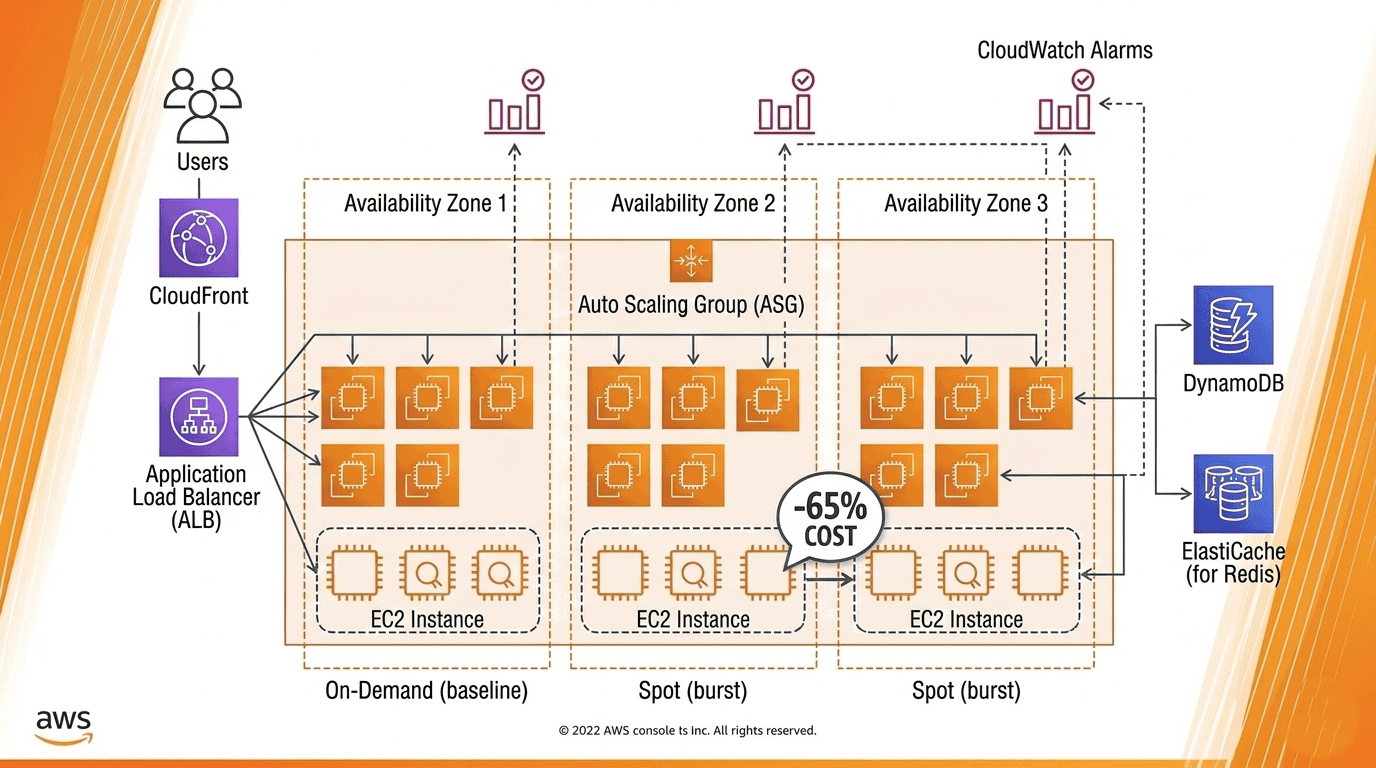
A startup was preparing for a product launch. Their initial architecture called for always-on m5.large instances behind an ALB. While secure, their projected cost was unsustainable.
The Exam-Like Problem: Design a cost-optimized, resilient architecture for a web app with unpredictable traffic bursts.
The Solution We Architected:
- Use Auto Scaling Groups with a mix of On-Demand (for baseline) and Spot Instances (for burst capacity)
- Place instances across multiple Availability Zones
- Implement an Application Load Balancer
- Use CloudWatch alarms for scaling
- Store session state in DynamoDB or ElastiCache to make web servers stateless
The Lesson: This solution cut projected compute cost by over 65% while maintaining reliability. The SAA-C03 wants you to think in these terms: multi-faceted, balancing pillars, and always conscious of the bottom line.
The Hands-On Gap
One professional who failed the AWS Data Engineer exam shared this powerful insight: "I had 4 years of experience using AWS daily. I built Glue jobs and maintained Redshift clusters. And I failed. Badly. Why? I hadn't practiced specific configurations—Glue crawler settings, Redshift distribution keys, Kinesis shard calculations. The hands-on experience filled gaps I didn't know I had."
Takeaway: Even experienced professionals need targeted practice. Don't assume your day job covers exam scenarios.
Chapter 7: Common Mistakes to Avoid – A Consultant's Warning List
1. Ignoring the "Why": You know S3 Cross-Region Replication exists. But do you know it's asynchronous and doesn't maintain ACLs? Surface-level knowledge fails.
2. Neglecting Cost Optimization: In a scenario with two technically sound solutions, the cheaper one is usually correct.
3. Over-Reliance on Dumps: These are unethical, often inaccurate, and violate AWS policy. AWS uses statistical analysis to detect anomalies, which risks invalidation.
4. Poor Time Management: Spending 5 minutes on one question can doom the final 10. Mark, guess, and review.
5. Skipping Hands-On Practice: Reading about VPCs is not the same as configuring one. Labs are non-negotiable.
6. Ignoring Domain Weights: Heavy networking skills won't compensate for weak identity or storage knowledge.
7. Not Taking Timed Practice Exams: Taking practice tests under timed conditions builds the mental stamina needed for 130 minutes of focused work.
Chapter 8: Frequently Asked Questions (FAQ)
Q1: How long should I study for the SAA-C03 exam?
A: For those with 1-2 years of hands-on AWS experience, 6-8 weeks of dedicated, part-time study (10-15 hours/week) is typical. Beginners may need 3-4 months.
Q2: Can I pass with just 30 hours of study?
A: Yes, but only with significant prior cloud experience. One candidate passed with 31 hours of study using only practice exams and focused review, but they already had Azure Fundamentals and hands-on cloud experience.
Q3: What's the single most important resource?
A: There is no single resource. A winning strategy combines official AWS learning materials, extensive hands-on practice, and high-quality scenario-based practice exams.
Q4: Are AWS exam vouchers from third parties legitimate?
A: Yes, when sourced from authorized partners. Our vouchers are identical to those purchased directly from AWS and are redeemed on the same Pearson VUE platform.
Q5: Can I use the SAA-C03 voucher for online proctored exams?
A: Absolutely. AWS SAA-C03 exam vouchers are valid for both online proctored testing from home and in-person testing at any Pearson VUE center worldwide.
Q6: What happens if my exam gets invalidated for "statistical anomalies"?
A: Some candidates have reported their exams being invalidated post-facto without warnings during the test. To avoid this, never use brain dumps, avoid suspicious movements during online proctoring (such as lip-reading), and consider taking exams at physical test centers.
Q7: Is SAA-C03 still the current exam in 2026?
A: Yes, as of early 2026, SAA-C03 remains the active exam series. Always verify on the official AWS Certification site before scheduling.
Q8: Do I need coding knowledge for the exam?
A: No, coding is not required. The exam focuses on architecture, services, and best practices.
Q9: What's the passing score?
A: 720 on a scale of 100-1000.
Q10: What should I take after SAA-C03?
A: Consider the AWS Certified Solutions Architect – Professional, or branch into AWS Security, Data Analytics, or DevOps certifications.
Conclusion & Your Next Steps
The path to AWS Solutions Architect Associate is a journey of developing an architectural mindset. You've moved from understanding the high failure rate to a concrete, step-by-step framework to advanced strategies that separate passers from high scorers.
Now it's time to take action. Here's your roadmap for the next eight weeks:
Phase 1: Foundation – Weeks 1 to 2
Start by downloading the official exam guide and reviewing the domain weights. Take a baseline assessment to identify your starting point. Set up your AWS Free Tier account with billing alerts so you can practice without worrying about unexpected costs. This phase is about orienting yourself and building the groundwork.
Phase 2: Core Learning – Weeks 3 to 5
This is where the real work happens. Focus on one domain at a time, starting with Security and Resilience, since they account for over half the exam. For each domain, combine reading, video watching, and most importantly, hands-on labs. You can't pass this exam without practical experience.
Phase 3: Integration – Weeks 6 to 7
Start taking timed practice exams, but don't just focus on your score. Review every question you got wrong and understand why. Create a "miss log" tracking which domains trip you up. Then go back and strengthen those weak areas. This is where most candidates see their biggest improvements.
Phase 4: Simulation – Week 8
Take full-length, timed practice exams under conditions that mirror the real test—130 minutes, no interruptions, no phone, no bathroom breaks. Target a score of 85% or higher before scheduling your actual exam. Create one-page cheat sheets for high-yield topics and review them daily.
Ready to begin?
Start with our comprehensive AWS Exam Preparation Guide 2026 – Study Plan & Tips for a complete timeline with weekly activities.
And when you're ready to test your knowledge with exam-style questions, our EvolveSkill AWS SAA-C03 Practice Exam Kit includes 400+ scenario-based questions with detailed explanations to help you identify weak areas before exam day.
👉 Get the EvolveSkill Practice Exam Kit Here
👉 Secure Your Discounted SAA-C03 Exam Voucher
Related Resources
AWS Certification Roadmap 2026 (A Trainer's Guide)
How to Save Money on AWS Certification Exams (2026 Guide)
AWS Exam Preparation Guide 2026 – Study Plan & Tips
AWS vs Azure Certification Guide: Your Best Career Move in 2026
Comments ()