

CompTIA Security+ vs CySA+: Which Cybersecurity Certification Should You Choose in 2026?
Introduction
Cybersecurity isn't just a career—it's a calling. With global demand for skilled defenders outstripping supply, the path you choose today determines the opportunities you unlock tomorrow. But here's the dilemma that stops countless aspiring professionals in their tracks:
Should you pursue CompTIA Security+ or CySA+ first?
Both are premier credentials from the industry-respected CompTIA. Both validate critical cybersecurity competencies. Yet they serve fundamentally different purposes, target distinct skill levels, and open doors to separate—though overlapping—career trajectories.
I've spent fifteen years in cybersecurity operations and certification training. I've watched junior analysts struggle because they skipped foundational knowledge, and I've seen experienced technicians stall because they never developed analytical depth. This guide exists to ensure you don't make either mistake.
By the end, you'll understand precisely where each certification fits in your professional journey, which one delivers superior ROI for your specific situation, and how to sequence them for maximum career acceleration in 2026.
Understanding the Cybersecurity Certification Landscape in 2026
Before we pit Security+ against CySA+, we need context. The cybersecurity profession isn't monolithic. It's a layered discipline that requires different competencies at each stage.
The Three Layers of Technical Cybersecurity Certification:
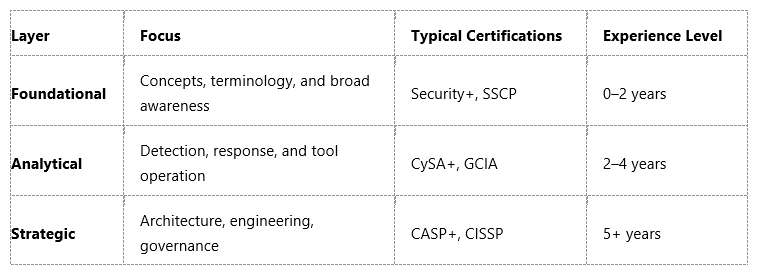
CompTIA has deliberately engineered Security+ and CySA+ to occupy the first two layers. They are not competitors—they are complementary stages in a coherent professional development arc.
Industry Context: According to CompTIA's 2025 Workforce and Learning Trends report, organizations are increasingly prioritizing "defensible security" over checkbox compliance. This shift favors professionals who possess both foundational knowledge (Security+) and analytical capability (CySA+).
What Is CompTIA Security+? (SY0-701)
CompTIA Security+ is the cybersecurity industry's baseline standard. It's not a certification you earn to impress—it's a certification you earn to qualify.
Since its introduction in 2002, Security+ has become the most widely adopted vendor-neutral security certification globally, with over 600,000 certified professionals. The current SY0-701 exam, released in late 2023, reflects the modern threat landscape while maintaining its core mission: validating that you understand how to secure systems, not just how to memorize facts.
What Security+ Actually Tests
Security+ assesses your ability to execute entry-level security tasks with supervision. The exam domains reveal their practical foundation:
Security+ (SY0-701) Exam Domains:
- General Security Concepts (12%): Core principles, confidentiality/integrity/availability triad, governance fundamentals
- Threats, Vulnerabilities, and Mitigations (22%): Attack types, indicator identification, basic remediation
- Security Architecture (18%): Network security, virtualization, cloud concepts
- Security Operations (28%): Incident response procedures, access controls, identity management
- Security Program Management and Oversight (20%): Risk management, compliance, security policies
The Unstated Objective: Security+ certifies that you can speak the language of security professionals and execute standard operating procedures correctly.
Who Should Earn Security+?
Ideal Candidate Profile:
- Career switchers with 0–2 years of IT experience
- Help desk or desktop support technicians moving into security
- Students pursuing undergraduate cybersecurity degrees
- Military personnel transitioning to civilian cybersecurity roles
- Non-security IT professionals (networking, systems) adding security competency
When Security+ Is Non-Negotiable:
Many government and defense contractors require Security+ for roles that involve privileged system access. The DoD Directive 8570/8140 mandates Security+ for Information Assurance Technician Level II positions. This isn't optional—it's the key to the door.
Real-World Job Outcomes
Common Job Titles After Security+:
- Security Administrator
- Junior Security Analyst
- IT Support Specialist (security-focused)
- Systems Administrator (with security responsibilities)
- SOC Analyst Trainee
Salary Expectations (U.S.): $70,000–$85,000
From the Trenches: I mentored a former automotive technician who earned his Security+ at age 38. Within four months, he secured a security administrator role at a regional bank. His technical aptitude was always evident—Security+ simply gave employers confidence in it.
What Is CompTIA CySA+? (CS0-003)
CompTIA Cybersecurity Analyst (CySA+) represents a significant elevation in both difficulty and professional expectation. This is not a certification for beginners. It's a certification for practitioners.
Released in 2017 and updated to CS0-003 in 2023, CySA+ was CompTIA's strategic response to the industry's need for professionals who could analyze security data, not just follow procedures. It bridges the gap between foundational knowledge and advanced engineering.
What CySA+ Actually Tests
CySA+ assesses your ability to independently detect, analyze, and respond to threats using common security tools and frameworks.
CySA+ (CS0-003) Exam Domains:
- Threat and Vulnerability Management (22%): Threat hunting, vulnerability scanning, prioritization
- Software and Systems Security (18%): Secure software development, application security testing
- Security Operations and Monitoring (25%): SIEM configuration and analysis, network monitoring, log review
- Incident Response (23%): Detection, containment, eradication, recovery procedures
- Compliance and Assessment (12%): Control frameworks, audit preparation, reporting
The Critical Difference: Security+ asks "What should you do?" CySA+ asks, "What is happening right now, and how do you prove it?"
Who Should Earn CySA+?
Ideal Candidate Profile:
- Security+ holders with 1–3 years of hands-on experience
- Current SOC analysts are seeking formal validation
- IT professionals migrating from generalist to specialist roles
- College graduates with security degrees seeking competitive differentiation
Prerequisite Reality: While CompTIA lists no official prerequisites, attempting CySA+ without Security+ or equivalent experience is analogous to building the second floor before the first. Technically possible. Practically inadvisable.
Real-World Job Outcomes
Common Job Titles After CySA+:
- SOC Analyst
- Threat Intelligence Analyst
- Vulnerability Management Specialist
- Cybersecurity Analyst
- Incident Response Technician
Salary Expectations (U.S.): $90,000–$110,000
Data Point: According to the U.S. Bureau of Labor Statistics, Information Security Analysts earn a median annual wage of $112,000. CySA+ holders typically position within the upper quartile of this range due to their demonstrated analytical capability.
Security+ vs CySA+: The Definitive Comparison
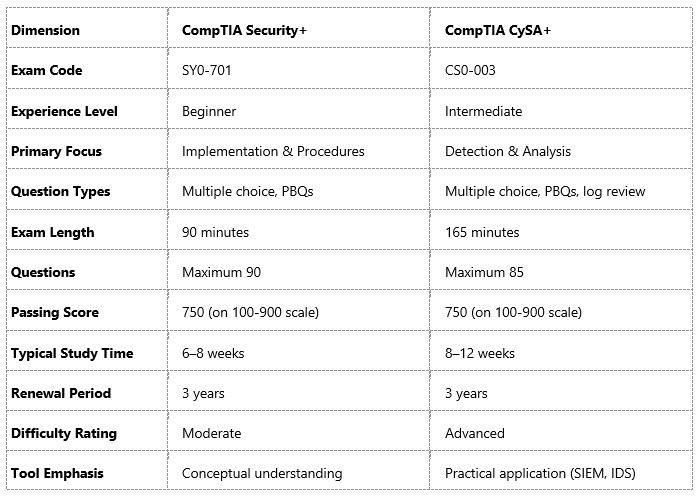
Let's move beyond generalities. Here is the objective, side-by-side analysis of how these certifications differ across every meaningful dimension.
Comparative Analysis Table
Philosophical Difference
The gap between these certifications isn't merely quantitative—it's qualitative.
Security+ certifies that you follow instructions correctly. You are given a scenario and expected to select the appropriate policy, control, or remediation.
CySA+ certifies that you interpret ambiguous data correctly. You are given logs, alerts, and scan results—and expected to deduce what occurred, what remains vulnerable, and what to prioritize.
This distinction manifests in the performance-based questions. Security+ PBQs might ask you to configure firewall rules or match threats to mitigations. CySA+ PBQs presents an SIEM dashboard with active alerts and asks you to triage incidents while the organization's leadership waits for your assessment.
The Natural Learning Progression
If you're feeling uncertain about which certification to pursue, consider this question:
Do you know what you don't know?
If the answer is no—if security concepts still feel abstract and tool names blur together—your path begins with Security+.
If the answer is yes—if you understand the fundamentals but struggle to apply them independently—your next step is to take the CySA+ exam.
The Recommended Certification Sequence:
A+ → Network+ → Security+ → CySA+ → PenTest+ / CASP+.
Each certification builds upon the previous. Security+ assumes the networking knowledge validated by Network+. CySA+ assumes the security fundamentals validated by Security+. CASP+ assumes the analytical capability validated by CySA+.
Why This Sequence Works:
- Cognitive load management: You're not learning networking, security concepts, and threat analysis simultaneously
- Employer signal clarity: Each certification clearly communicates your current capability level
- Compounding ROI: Salary increases accelerate after CySA+, but you need Security+ to reach that stage
From the Trenches: A former student—we'll call him Marcus—attempted CySA+ immediately after earning Network+. He failed by 40 points. Discouraged, he spent three months studying for Security+, then returned to CySA+ and passed with ease. "I didn't realize how much foundational context I was missing," he told me. "Security+ wasn't a detour. It was the bridge."
Strategic ROI Analysis for 2026
Certifications represent investments of time, money, and cognitive energy. Let's evaluate the return on each credential's investment.
Security+ ROI Profile
Investment:
- Study time: 60–80 hours
- Exam voucher: $392 (retail)
- Study materials: $100–$500
Returns:
- Entry eligibility for approximately 65% of cybersecurity job postings
- DoD 8570/8140 compliance
- Foundation for all subsequent security certifications
- Average salary premium of $15,000–$20,000 over non-certified peers
Verdict: Security+ remains the highest-ROI entry credential in cybersecurity. No alternative offers comparable market access at this investment level.
CySA+ ROI Profile
Investment:
- Study time: 80–120 hours
- Exam voucher: $404 (retail)
- Study materials: $200–$600
Returns:
- Advancement from tier 1 to tier 2 SOC roles
- Average salary premium of $20,000–$30,000 over Security+ alone
- Demonstrated analytical capability (employers' highest-demand skill)
- Pathway to CISSP and advanced certifications
Verdict: CySA+ delivers exceptional ROI for candidates who have already secured foundational credentials. For beginners, it represents premature optimization.
The Bundle Advantage
Smart Strategy: Many candidates maximize ROI by purchasing Security+ and CySA+ vouchers together. CompTIA's exam fees increase annually by approximately 5–7% in 2025 alone. Securing both vouchers at 2026 pricing through authorized providers like EvolveSkill's CompTIA voucher bundles effectively locks in savings while you complete your certification journey.
Common Mistakes Candidates Make
After observing thousands of certification candidates, certain failure patterns emerge consistently. Here are the most costly errors—and how to avoid them.
Security+ Mistakes
Mistake 1: Memorizing Port Numbers Instead of Context
Candidates obsess over memorizing port 445 vs 139 while neglecting to understand when SMB traffic indicates legitimate file sharing versus ransomware propagation.
Solution: For every protocol, ask "What does normal look like? What indicates attack?"
Mistake 2: Dismissing Performance-Based Questions
PBQs constitute approximately 30% of your exam score but receive disproportionately little study attention.
Solution: Dedicate 40% of your practice time to PBQ simulations.
Mistake 3: Cramming
Security+ requires conceptual integration, not fact recall. Cramming produces temporary retention that collapses under scenario-based questioning.
Solution: Distribute study across 6–8 weeks with consistent daily practice.
CySA+ Mistakes
Mistake 1: Insufficient Tool Familiarity
CySA+ expects you to interpret SIEM dashboards, IDS alerts, and vulnerability scan reports. Conceptual knowledge is insufficient.
Solution: Download and explore Security Onion, Splunk Free, or Wireshark. Understand what common alerts look like in production interfaces.
Mistake 2: Ignoring Log Formats
Many candidates understand threat indicators but cannot parse Windows Event IDs, syslog formats, or web server logs.
Solution: Practice log analysis daily. Know the difference between Event ID 4625 and 4720 without looking it up.
Mistake 3: Weak Triage Prioritization
CySA+ presents multiple simultaneous incidents. Candidates who cannot prioritize based on business impact and exploitability fail.
Solution: Practice the question: "Which alert do you investigate first, and why?"
Which Certification Offers Better ROI in 2026?
Both certifications remain in high demand, but in 2026:
- Security+ offers broader entry-level access across industries (finance, healthcare, education).
- CySA+ accelerates career progression once you have foundational experience.
ROI Summary:
- Security+ → Ideal if you’re entering cybersecurity or shifting careers.
- CySA+ → Ideal if you already have hands-on security experience and want senior roles.
Real-World Study Strategy (2026 Edition)
Based on analysis of successful candidates, here is the optimal preparation approach for each certification.
Security+ Study Framework
Phase 1: Assessment (Week 1)
- Download SY0-701 exam objectives
- Take a diagnostic practice exam
- Identify weak domains
Phase 2: Foundation (Weeks 2–4)
- Complete video course (Professor Messer, Dion Training, or EvolveSkill)
- Read one comprehensive study guide
- Create domain-specific notes
Phase 3: Application (Weeks 5–6)
- Daily PBQ practice
- Scenario-based question drills
- Hands-on labs (basic firewall configuration, access control implementation)
Phase 4: Validation (Weeks 7–8)
- Timed full-length practice exams
- Target score: 85%+ before scheduling
- Review all incorrect answers
CySA+ Study Framework
Phase 1: Tool Familiarization (Weeks 1–2)
- Install and explore SIEM demonstration environments
- Practice log analysis with sample datasets
- Understand vulnerability scan interpretation
Phase 2: Domain Deep Dive (Weeks 3–6)
- Focus on Threat Management and Incident Response (45% combined weight)
- Study attack lifecycles and corresponding detection methods
- Master compliance frameworks (NIST, ISO, PCI-DSS)
Phase 3: Scenario Mastery (Weeks 7–9)
- Complex incident response simulations
- Multi-domain PBQs
- Triage exercises with competing priorities
Phase 4: Exam Readiness (Weeks 10–12)
- Full-length practice exams under timed conditions
- Remediation of persistent weak areas
- Mental preparation for a 165-minute endurance test
Expert Recommendation
If you are:
- New to cybersecurity → Start with Security+ SY0-701
- Already have Security+ or 2–3 years of experience → Move to CySA+ CS0-003
Ultimate combo:
Security+ + CySA+ = Complete foundation + advanced defense expertise 🔥
And yes, you can save more when you bundle both exams.
👉 Check EvolveSkill’s CompTIA Study Material & Voucher Bundles
Frequently Asked Questions
Q: Can I take CySA+ without Security+?
A: Technically, yes. Strategically, rarely. Unless you possess equivalent knowledge through military training or extensive on-the-job experience, Security+ provides essential foundational concepts that CySA+ assumes.
Q: Which certification has higher pass rates?
A: Security+ passes at approximately 82–85% among prepared candidates. CySA+ pass rates are lower—estimated at 70–75%—reflecting its greater difficulty and the self-selection of less-prepared candidates who attempt it prematurely.
Q: Which certification pays more?
A: CySA+ commands higher salaries because it certifies more experienced professionals for more senior roles. This is a function of career progression, not certification superiority.
Q: How long are these certifications valid?
A: Both require renewal every three years via CompTIA's Continuing Education (CE) program. You can also renew by earning higher-level certifications—for example, CySA+ renews Security+.
Q: Which certification is better for government work?
A: DoD 8570/8140 requires Security+ for IAT Level II roles. CySA+ satisfies CSSP Analyst requirements. Many defense contractors value both.
Q: Should I get both certifications?
A: For career cybersecurity professionals, absolutely. Security+ opens the door. CySA+ moves you through it. Together, they represent a complete arc from foundational to analytical.
Q: Where can I find affordable exam vouchers?
A: Retail pricing from CompTIA continues rising. Authorized providers such as EvolveSkill offer significant discounts on Security+ and CySA+ vouchers, with additional savings on bundled purchases.
See How to Pass CompTIA Security+ on Your First Attempt
H2: Conclusion & Your Next Step
The Security+ versus CySA+ question isn't about which certification is "better." It's about where you stand today and where you intend to go.
If you're entering cybersecurity, Security+ is your starting line. It provides the vocabulary, framework, and credibility you need to secure your first security role. Do not bypass it.
If you're already in security: CySA+ is your accelerator. It validates that you've moved beyond task execution into genuine threat analysis—the skill employers desperately need and reward.
If you're uncertain: Begin with Security+. The six weeks of study aren't a detour; it's the shortest path to clarity about your readiness for advanced certification.
The cybersecurity profession needs both practitioners and analysts. It needs professionals who can follow procedures and professionals who can improve them. Security+ and CySA+ exist to develop and recognize both capabilities.
Your only remaining question:
Are you ready to begin?
Explore CompTIA Security+ and CySA+ Study Bundles →
Related Resources
- CompTIA Network+ N10-009 Study Guide – Pass Your Exam
- CompTIA Certification Roadmap 2026
- How to Save Money on IT Certification Exams
DISCLAIMER: EvolveSkill is an independent training provider and is not affiliated with CompTIA. All practice questions are original, designed to reflect the scope and style of the CompTIA Security+ exam, and aligned with public objectives. CompTIA and Security+ are registered trademarks of the Computing Technology Industry Association, Inc.
Comments ()