

AWS Certifications List 2026 – Complete Guide to All AWS Certifications
Cloud computing isn’t just the future; it’s the present. And in 2026, Amazon Web Services (AWS) remains the undisputed leader, powering everything from startups to government agencies. If you are looking to validate your skills, boost your salary, or pivot into a cloud career, an AWS certification is your golden ticket.
But with so many options, where do you start? This AWS certifications list 2026 guide is your ultimate roadmap. We will break down every credential, from the foundational Cloud Practitioner to the elite Professional and Specialty certifications. By the end of this post, you will know exactly which certification aligns with your career goals and—most importantly—how to save money on your exam using discounted AWS certification vouchers from Evolveskill.
Let’s dive in.
AWS Certifications Overview (Quick Summary)
AWS certifications are the industry standard for validating cloud expertise. As of 2026, the AWS certification portfolio is organized into four distinct levels and five Specialty domains.
- Total Certifications: 13 (including the new AI Practitioner and CloudOps Engineer roles)
- Levels: Foundational, Associate, Professional, and Specialty
- Who They Are For: Whether you are a student, developer, system administrator, or seasoned IT architect, there is a certification designed to validate your specific skill set.
- Global Recognition: AWS certifications consistently rank among the highest-paying IT certifications worldwide, with certified professionals earning 20–30% more than their non-certified peers.
AWS updates its exams regularly to reflect the latest services and best practices. In 2026, expect a continued emphasis on AI/ML, data engineering, and security—three domains where AWS is aggressively innovating.
AWS Certification Levels Explained
To navigate the AWS certification list, you first need to understand the hierarchy. AWS structures its exams based on experience level and job role. Each level builds on the previous one, creating a natural progression path for your career.
Foundational Level
This is the entry point. It requires no prior AWS experience. It is designed to validate a high-level understanding of AWS Cloud concepts, services, and the shared responsibility model. Think of it as your "cloud driver's license"—it proves you know the rules of the road, even if you haven't built a car yet.
Associate Level
This is the most popular tier for IT professionals. Associate-level certifications require some hands-on experience (typically 6–12 months) and dive deep into designing, deploying, and managing applications on AWS. These are the certifications that open doors to cloud engineering roles.
Professional Level
These are the hardest exams in the AWS portfolio. They are designed for experienced professionals (2+ years of hands-on experience) who can design complex, high-performance, and secure architectures or manage intricate DevOps pipelines. Passing a Professional exam signals to employers that you are a senior-level expert.
Specialty Certifications
These are niche, technical deep-dives. They do not follow a strict "level" progression but are generally considered as difficult as, or harder than, Professional exams. They focus on specific domains like security, machine learning, or networking. If you have a specialized role, these certs make you invaluable.
Complete AWS Certifications List (2026 Updated)
This is the core of our guide. Below is the complete, up-to-date list of AWS certifications for 2026, including the new releases you need to know about. For each certification, we’ve included detailed insights on difficulty, career value, and study recommendations.
Foundational (Entry-Level)
AWS Certified Cloud Practitioner (CLF-C02)
- Who it’s for: Non-technical roles (sales, marketing, managers), students, or absolute beginners looking to get their feet wet.
- Difficulty: Easy.
- Career Value: High for non-technical resumes; low for engineering roles unless you are just starting. It’s the perfect first step.
- Exam Focus: Covers basic AWS services, cloud concepts, pricing models, security fundamentals, and the AWS Well-Architected Framework.
- Salary Impact: Entry-level roles can expect a 10–15% salary boost with this cert, but its real value is as a stepping stone.
- Recommended? Yes. If you have zero cloud experience, start here to learn the vocabulary and basic concepts. It builds confidence and sets you up for success on harder exams.
AWS Certified AI Practitioner (AIF-C01)
- Who it’s for: Business leaders, developers, and IT pros looking to understand AI/ML concepts without diving into deep coding.
- Difficulty: Easy to Moderate.
- Career Value: Exploding in 2026. This cert shows you understand AI ethics, foundational models, and how to use AI services like Bedrock, SageMaker, and Amazon Q.
- Exam Focus: AI/ML terminology, use cases for generative AI, responsible AI practices, and how to integrate AI services into applications.
- Salary Impact: Early adopters with this cert are seeing strong demand as companies scramble to implement AI solutions.
- Recommended? Absolutely. AI is everywhere. This cert future-proofs your resume for the AI-driven cloud era. Even non-technical managers should consider it.
Associate Level (Core Roles)
AWS Certified Solutions Architect Associate (SAA-C03)
- Who it’s for: Solutions architects, cloud engineers, and developers.
- Difficulty: Moderate.
- Career Value: The King of AWS Certs. This is the most sought-after certification in the industry. It validates your ability to design resilient, cost-optimized, and high-performing architectures.
- Exam Focus: EC2, S3, VPC, Lambda, RDS, Aurora, IAM, load balancers, auto-scaling, and disaster recovery strategies.
- Salary Impact: Professionals with this cert earn $130,000–$160,000 on average in the US, making it one of the highest-ROI certifications available.
- Recommended? 100%. If you can only take one certification, make it this one. It serves as the foundation for almost every other AWS credential.
AWS Certified Developer Associate (DVA-C02)
- Who it’s for: Software developers who write code for AWS.
- Difficulty: Moderate.
- Career Value: High for coding roles. Focuses on API calls, Lambda functions, interacting with DynamoDB, and deploying applications using CI/CD pipelines.
- Exam Focus: AWS SDKs, Lambda, API Gateway, DynamoDB, S3, CodeSuite services, and application lifecycle management.
- Salary Impact: Developers with this cert typically earn $120,000–$150,000.
- Recommended? Yes. If you write code daily, this complements the Solutions Architect cert perfectly. Together, they form a powerful combination.
AWS Certified SysOps Administrator Associate (SOA-C02)
- Who it’s for: System administrators in a cloud operations role (SysOps).
- Difficulty: Moderate to High (often considered the hardest Associate).
- Career Value: Great for Ops and DevOps roles. Focuses on deployment, management, monitoring, and operations.
- Exam Focus: CloudWatch, Systems Manager, AWS Config, backup and recovery, patching, and incident response.
- Salary Impact: SysOps specialists earn $115,000–$145,000.
- Recommended? Yes. If your job title includes "Administrator" or "Ops," this is your cert. It proves you can keep the lights on in production environments.
AWS Certified CloudOps Engineer Associate (SOA-C03)
- Who it’s for: This is the new evolution of the SysOps role, focusing on continuous improvement, automation, and operational excellence.
- Difficulty: Moderate to High.
- Career Value: Very high. It signals that you understand modern operational practices such as observability, incident response, and infrastructure as code.
- Exam Focus: Modernized content with more emphasis on automation, IaC (Terraform, CloudFormation), and observability tools.
- Recommended? Yes. This is the future of operations roles in AWS. It replaces the traditional SysOps mindset with a DevOps-aligned approach.
AWS Certified Data Engineer Associate (DEA-C01)
- Who it’s for: Data engineers responsible for building data pipelines and ETL processes.
- Difficulty: Moderate.
- Career Value: Skyrocketing. Data is the new oil, and this cert proves you know how to refine it using AWS tools like Glue, Redshift, EMR, and Kinesis.
- Exam Focus: ETL pipelines, data cataloging, data storage optimization, and orchestration tools.
- Salary Impact: Data engineers with this cert command $130,000–$170,000.
- Recommended? Yes. For anyone in big data or analytics, this is becoming a mandatory credential.
AWS Certified Machine Learning Engineer Associate (MLA-C01)
- Who it’s for: Engineers who deploy, operationalize, and scale ML models (MLOps).
- Difficulty: Moderate to High.
- Career Value: Huge. This cert bridges the gap between data science and software engineering, a critical skill in 2026.
- Exam Focus: SageMaker pipelines, model deployment, inference endpoints, monitoring, and CI/CD for ML.
- Salary Impact: MLOps engineers earn $140,000–$180,000.
- Recommended? Yes. If you work with data science teams or ML models, this cert proves you can take models from notebook to production.
Professional Level (Expert)
AWS Certified Solutions Architect Professional (SAP-C02)
- Who it’s for: Senior architects with 2+ years of experience designing complex enterprise environments.
- Difficulty: Very Hard.
- Career Value: Extremely high. This is the pinnacle for architects. It commands top salaries and executive respect.
- Exam Focus: Multi-account strategies (AWS Organizations), advanced networking (Transit Gateway), cost optimization at scale, and complex migration strategies.
- Salary Impact: Professionals with this cert earn $160,000–$210,000+.
- Recommended? If you have experience. Do not attempt this without the Associate cert and real-world experience. It’s a beast, but the payoff is worth it.
AWS Certified DevOps Engineer Professional (DOP-C02)
- Who it’s for: Senior DevOps engineers and automation specialists.
- Difficulty: Very Hard.
- Career Value: Extremely high. Validates your ability to automate complex CI/CD pipelines, infrastructure as code, and configuration management.
- Exam Focus: CodePipeline, CodeDeploy, CloudFormation, Elastic Beanstalk, OpsWorks, and advanced monitoring strategies.
- Salary Impact: Senior DevOps engineers with this cert earn $160,000–$200,000.
- Recommended? If you have experience. This is the ultimate ops cert. Pair it with the Solutions Architect Professional for the "unicorn" resume.
Specialty Certifications (Niche)
AWS Certified Security Specialty (SCS-C03)
- Who it’s for: Security architects, engineers, and compliance officers.
- Difficulty: Hard.
- Career Value: Top-tier. Security is a non-negotiable priority for all companies. This cert proves you can secure AWS workloads against threats.
- Exam Focus: IAM policies, KMS encryption, CloudTrail, GuardDuty, Inspector, and incident response.
- Salary Impact: Security specialists earn $140,000–$180,000.
- Recommended? Yes. For anyone in security or compliance roles, this is the gold standard.
AWS Certified Machine Learning Specialty (MLS-C01)
- Who it’s for: Data scientists and ML engineers who build and train models.
- Difficulty: Hard.
- Career Value: High, though the new MLA-C01 is gaining traction for operational roles. This remains excellent for pure model training and data science.
- Exam Focus: SageMaker (deep dive), feature engineering, model tuning, and business problem framing.
- Recommended? Yes. If you are a data scientist, this cert validates your ability to build ML solutions on AWS.
AWS Certified Advanced Networking Specialty (ANS-C01)
- Who it’s for: Network engineers and architects managing hybrid and complex network designs.
- Difficulty: Very Hard (often considered the hardest AWS exam).
- Career Value: Niche but highly valuable. If you work with Direct Connect, Route 53, Transit Gateway, and complex VPC designs, this is for you.
- Exam Focus: Network automation, hybrid connectivity, routing protocols, and advanced security groups.
- Salary Impact: Network specialists earn $150,000–$190,000.
- Recommended? Only if you specialize in networking. This is not for generalists.
AWS Certified Data Analytics Specialty (DAS-C01)
- Who it’s for: Data analysts and data engineers.
- Difficulty: Hard.
- Career Value: Good, though the Data Engineer Associate is the more modern path for building pipelines. This focuses more on visualization, analysis, and querying.
- Exam Focus: Redshift, QuickSight, Athena, Kinesis Analytics, and data visualization best practices.
- Recommended? Maybe. Choose the Data Engineer Associate if you are building pipelines; choose this if you are analyzing data and building dashboards.
Which AWS Certification Should You Choose?
Feeling overwhelmed? Let’s simplify. Based on your role, here is the AWS certification roadmap you should consider:
- For Beginners: Start with the AWS Certified Cloud Practitioner (CLF-C02). Learn the basics, then move to Solutions Architect Associate (SAA-C03).
- For Developers: Go for Developer Associate (DVA-C02) first, then Solutions Architect Associate. If you work with AI, add Machine Learning Engineer Associate (MLA-C01).
- For Cloud Engineers/Architects: The golden path is Solutions Architect Associate (SAA-C03) -> Solutions Architect Professional (SAP-C02).
- For Security Professionals: Security Specialty (SCS-C02) is your target. You might pair this with the Solutions Architect Associate for a well-rounded profile.
- For Operations/DevOps: Start with SysOps Admin (SOA-C02) or the new CloudOps Engineer (SOA-C03), then advance to DevOps Engineer Professional (DOP-C02).
- For Data Professionals: Take the Data Engineer Associate (DEA-C01) first, then consider the Data Analytics Specialty (DAS-C01) or the Machine Learning Engineer Associate (MLA-C01), depending on your focus.
For a more detailed step-by-step plan, check out our deep dive: AWS Certification Roadmap 2026 (A Trainer's Guide).
AWS Certification Cost (2026 Breakdown)
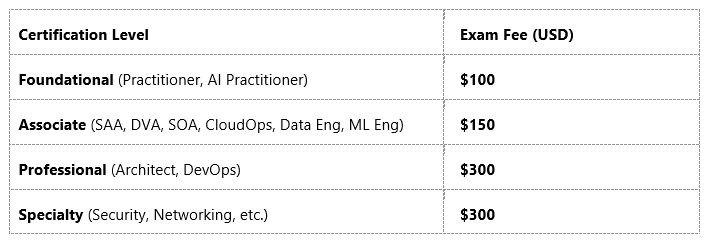
If you are planning to take multiple exams (which we recommend), the costs add up quickly. A full Associate-to-Professional path can cost nearly $1,000. Factor in retakes (which happen—no shame in that), and you could be looking at even more.
That’s why smart candidates always look for discounts before registering.
How to Save Money on AWS Certification Exams
Let’s be honest—exam fees are expensive. But you don’t have to pay full price. At Evolveskill, we specialize in helping you cut these costs.
The smartest way to save is by purchasing AWS certification discount vouchers. Instead of paying AWS the full $150 or $300, you can get a discounted voucher from us. It’s the exact same registration code, just at a lower price.
Get your discounted exam voucher here: AWS Certification Exam Vouchers
We offer vouchers for every exam on this list, including the new AI Practitioner (AIF-C01) and all Specialty exams. Don’t leave money on the table. Check out our collection to see how much you can save: AWS Exam Vouchers Collection.
Pro Tip: Many candidates don’t realize that vouchers never expire. You can buy them now at a discount and schedule your exam months later when you’re fully prepared.
For more detailed saving strategies, read our dedicated guide: How to Save Money on AWS Certification Exams (2026 Guide).
AWS Certification Difficulty Comparison
To help you gauge the challenge ahead, here is a detailed comparison based on average student feedback, industry data, and pass rate statistics. Understanding the difficulty level of each certification will help you set realistic expectations, plan your study timeline, and avoid the frustration of attempting an exam before you're ready.
Foundational Level (Difficulty: 3/10)
These are entry-level exams designed for beginners. They focus on broad concepts rather than deep technical implementation.
AWS Certified Cloud Practitioner (CLF-C02)
- Difficulty Rating: 3 out of 10
- Recommended Study Time: 1–2 weeks
- Estimated Pass Rate: 85–90%
What Makes It This Difficult:
The Cloud Practitioner exam is intentionally accessible. It tests your understanding of basic cloud concepts, AWS core services, pricing models, security fundamentals, and the shared responsibility model. There are no complex architectural questions or hands-on troubleshooting scenarios. Questions are straightforward and multiple-choice.
Why People Pass:
- No prior AWS experience required
- Concepts are high-level and conceptual
- Wide availability of free and low-cost study materials
- A short study timeline keeps motivation high
Why People Fail:
- Underestimating the exam and not studying at all
- Confusion around pricing models (Reserved Instances vs. Savings Plans)
- Not understanding the Well-Architected Framework pillars
Preparation Advice:
Take one week to go through AWS Skill Builder's free Cloud Practitioner Essentials course. Spend another week taking practice exams. If you're consistently scoring 85% or higher, you're ready.
AWS Certified AI Practitioner (AIF-C01)
- Difficulty Rating: 3 out of 10
- Recommended Study Time: 2–3 weeks
- Estimated Pass Rate: 80–85%
What Makes It This Difficult:
This newer certification focuses on AI/ML concepts, generative AI, foundation models, and responsible AI practices. Like the Cloud Practitioner, it is foundational—meaning it tests knowledge of AI concepts rather than implementation. However, because AI is a rapidly evolving field, some candidates find the terminology and concepts unfamiliar.
Why People Pass:
- No coding or deep ML experience required
- Focuses on business use cases and ethical considerations
- AWS services like Bedrock, SageMaker, and Q are explained conceptually
Why People Fail:
- Confusion between different AI services (Bedrock vs. SageMaker)
- Lack of understanding of responsible AI and bias concepts
- Underestimating the breadth of AI topics covered
Preparation Advice:
Spend two weeks studying the official exam guide. Pay special attention to AI service use cases and responsible AI principles. Practice exams are essential here because the question style is unique.
Associate Level (Difficulty: 5–7/10)
Associate-level exams require hands-on experience (typically 6–12 months) and test your ability to design, deploy, and manage applications on AWS.
AWS Certified Developer Associate (DVA-C02)
- Difficulty Rating: 5 out of 10
- Recommended Study Time: 1–2 months
- Estimated Pass Rate: 60–70%
What Makes It This Difficult:
This is the easiest of the Associate-level exams. It focuses on writing code that interacts with AWS services—Lambda functions, API Gateway, DynamoDB, and S3. If you're already a developer, much of this content will feel familiar.
Why People Pass:
- Strong overlap with real-world development work
- Focus on specific services (Lambda, DynamoDB, API Gateway)
- Fewer networking and infrastructure questions
Why People Fail:
- Not enough hands-on experience with AWS SDKs
- Confusion around IAM permissions and authentication flows
- Underestimating DynamoDB query patterns and indexing
Preparation Advice:
Build a simple serverless application using Lambda, API Gateway, and DynamoDB. If you can do that from scratch, you're 80% prepared. Spend the remaining time on IAM policies and deployment strategies.
Difference.
AWS Certified Solutions Architect Associate (SAA-C03)
- Difficulty Rating: 6 out of 10
- Recommended Study Time: 2–3 months
- Estimated Pass Rate: 50–60%
What Makes It This Difficult:
This is the most popular AWS certification—and for good reason. It tests your ability to design resilient, cost-optimized, and high-performing architectures. The difficulty comes from the breadth of services covered (EC2, S3, VPC, RDS, Lambda, IAM, and more) and the scenario-based question format that requires you to choose the best solution among several viable options.
Why People Pass:
- Strong hands-on experience with core AWS services
- Deep understanding of high availability and disaster recovery
- Ability to eliminate wrong answers quickly
Why People Fail:
- Lack of hands-on experience (reading alone isn't enough)
- Difficulty with networking concepts (VPC, subnets, route tables)
- Not understanding cost optimization trade-offs
- Rushing to take the exam without enough practice
Preparation Advice:
This exam requires a structured study plan. Spend 6–8 weeks on courses and hands-on labs, then 2–4 weeks on practice exams. Aim for 85%+ on practice tests before scheduling the real exam. If you're scoring lower, you're not ready.
If you want to understand exactly where candidates go wrong—and how to ensure you're not one of them—read our complete analysis:
👉 Why 40% Fail the AWS SAA-C03 Exam & How to Pass (2026 Guide)
AWS Certified Data Engineer Associate (DEA-C01)
- Difficulty Rating: 6 out of 10
- Recommended Study Time: 2–3 months
- Estimated Pass Rate: 60–70%
What Makes It This Difficult:
This exam focuses on building and maintaining data pipelines using AWS services like Glue, Redshift, EMR, Kinesis, and Step Functions. The difficulty comes from the specialized nature of data engineering—you need to understand ETL processes, data cataloging, and orchestration.
Why People Pass:
- Experience with ETL tools and data pipelines
- Strong understanding of Glue, Redshift, and S3
- Familiarity with Python or Scala for data transformations
Why People Fail:
- Lack of hands-on experience with Glue and EMR
- Confusion around data storage formats (Parquet, ORC, Avro)
- Difficulty optimizing Redshift distribution styles and sort keys
Preparation Advice:
If you work as a data engineer, this exam validates your existing skills. If you're transitioning into data engineering, spend extra time building real pipelines using Glue and Redshift. Practice exams are critical for understanding the question style.
AWS Certified Machine Learning Engineer Associate (MLA-C01)
- Difficulty Rating: 6 out of 10
- Recommended Study Time: 2–3 months
- Estimated Pass Rate: 60–70%
What Makes It This Difficult:
This is the newer MLOps-focused certification. It tests your ability to deploy, operationalize, and scale machine learning models using SageMaker. Unlike the ML Specialty (which focuses on data science), this exam emphasizes CI/CD for ML, model monitoring, and infrastructure.
Why People Pass:
- Experience with SageMaker pipelines and model deployment
- Understanding of CI/CD concepts applied to ML
- Familiarity with containerization (Docker, ECR)
Why People Fail:
- Confusion between data science tasks and MLOps tasks
- Lack of hands-on experience with SageMaker Inference endpoints
- Underestimating model monitoring and drift detection
Preparation Advice:
Build an end-to-end ML pipeline using SageMaker Pipelines. Deploy a model to an endpoint and set up monitoring. If you can do this, you're well-prepared.
AWS Certified SysOps Administrator Associate (SOA-C02) & CloudOps Engineer Associate (SOA-C03)
- Difficulty Rating: 7 out of 10
- Recommended Study Time: 2–3 months
- Estimated Pass Rate: 50–65%
What Makes It This Difficult:
These are the hardest Associate-level exams. They focus on operational tasks—deployment, monitoring, patching, backup and recovery, and incident response. The difficulty stems from the depth of knowledge required and the need for operations professionals to understand how systems fail and how to recover them.
Why People Pass:
- Real-world experience managing production workloads
- Strong understanding of CloudWatch, Systems Manager, and AWS Config
- Experience with backup strategies and disaster recovery
Why People Fail:
- Lack of production operations experience
- Difficulty troubleshooting complex scenarios
- Underestimating the importance of logging and monitoring
Preparation Advice:
If you're not already working in an operations role, spend significant time in the AWS Console. Set up monitoring, create alarms, simulate failures, and practice recovery procedures. This exam rewards hands-on experience more than any other Associate.
Professional Level (Difficulty: 9/10)
Professional exams are designed for senior-level experts with 2+ years of experience. They test advanced design patterns, complex architectures, and enterprise-scale solutions.
AWS Certified Solutions Architect Professional (SAP-C02)
- Difficulty Rating: 9 out of 10
- Recommended Study Time: 4–6 months
- Estimated Pass Rate: 30–40%
What Makes It This Difficult:
This exam is a beast. It assumes you already have the Associate-level knowledge and adds complexity in multi-account strategies (AWS Organizations), advanced networking (Transit Gateway, Direct Connect), complex migration scenarios, and enterprise-scale security. Questions are long, scenario-based, and often have multiple "correct" answers—you must choose the best one.
Why People Pass:
- Several years of real-world AWS architecture experience
- Deep understanding of advanced networking and security
- Ability to think at enterprise scale (thousands of accounts, global deployments)
Why People Fail:
- Attempting the exam without the Associate certification first
- Lack of experience with multi-account governance
- Difficulty with advanced networking concepts
- Underestimating the time required to prepare
Preparation Advice:
Do not rush this exam. Spend 3–4 months on structured study, then 1–2 months on practice exams. The official AWS practice exam is much easier than the real thing—seek out third-party practice tests that are known to be more challenging. If you're not scoring 80%+ on difficult practice exams, you're not ready.
AWS Certified DevOps Engineer Professional (DOP-C02)
- Difficulty Rating: 9 out of 10
- Recommended Study Time: 4–6 months
- Estimated Pass Rate: 35–45%
What Makes It This Difficult:
This exam focuses on automation, CI/CD, infrastructure as code, and configuration management. It requires deep knowledge of CodePipeline, CodeDeploy, CloudFormation, and advanced monitoring. Like the Solutions Architect Professional, it assumes you have Associate-level knowledge and adds complexity around scaling, security, and operational excellence.
Why People Pass:
- Strong experience with CI/CD pipelines
- Deep understanding of CloudFormation and infrastructure as code
- Experience with blue/green deployments and canary releases
Why People Fail:
- Lack of hands-on experience with CodeSuite services
- Difficulty with advanced deployment strategies
- Underestimating the complexity of monitoring and logging at scale
Preparation Advice:
Build a complete CI/CD pipeline using CodePipeline, CodeBuild, and CodeDeploy. Implement blue/green deployments. Use CloudFormation to manage infrastructure. If you can do this without referring to documentation, you're on the right track.
Specialty Level (Difficulty: 8–9.5/10)
Specialty exams are deep dives into niche technical domains. They are generally considered as challenging as—or more challenging than—Professional exams, depending on your expertise.
AWS Certified Security Specialty (SCS-C03)
- Difficulty Rating: 8 out of 10
- Recommended Study Time: 3–4 months
- Estimated Pass Rate: 45–55%
What Makes It This Difficult:
This exam covers IAM policies, KMS encryption, CloudTrail, GuardDuty, Inspector, and incident response. The difficulty comes from the depth of security knowledge required—you need to understand not just how services work, but how to secure them against real-world threats.
Why People Pass:
- Background in security or compliance
- Deep understanding of IAM policies (including condition keys)
- Experience with encryption (KMS, CloudHSM)
Why People Fail:
- Lack of hands-on security experience
- Confusion around different encryption options (S3 encryption vs. EBS encryption)
- Underestimating incident response and forensics
Preparation Advice:
Spend time in IAM. Create complex policies with conditions. Experiment with KMS and CloudTrail. Security is about understanding how things can break—build systems, then try to break them and detect the break-in.
AWS Certified Machine Learning Specialty (MLS-C01)
- Difficulty Rating: 8 out of 10
- Recommended Study Time: 3–4 months
- Estimated Pass Rate: 45–55%
What Makes It This Difficult:
This exam focuses on data science—building, training, and tuning machine learning models using SageMaker. Unlike the MLA-C01 (which focuses on MLOps), this exam tests your understanding of algorithms, feature engineering, and model evaluation.
Why People Pass:
- Background in data science or machine learning
- Deep understanding of SageMaker (training, tuning, deployment)
- Familiarity with common ML algorithms (XGBoost, Linear Learner, etc.)
Why People Fail:
- Lack of hands-on experience with SageMaker
- Difficulty with feature engineering and hyperparameter tuning
- Confusion around evaluation metrics
Preparation Advice:
Build and train models in SageMaker. Experiment with different algorithms. Understand when to use XGBoost vs. Linear Learner vs. Deep Learning. This exam rewards practical experience.
AWS Certified Advanced Networking Specialty (ANS-C01)
- Difficulty Rating: 9.5 out of 10
- Recommended Study Time: 4–6 months
- Estimated Pass Rate: 30–40%
What Makes It This Difficult:
Many candidates consider this the hardest AWS certification. It covers VPC design, Transit Gateway, Direct Connect, Route 53, load balancing, and network security in depth. You need to understand routing protocols, BGP, and hybrid networking architectures.
Why People Pass:
- Background in traditional networking (CCNP/CCIE level)
- Deep understanding of VPC, subnets, route tables, and Transit Gateway
- Experience with Direct Connect and hybrid connectivity
Why People Fail:
- Lack of networking background
- Difficulty with BGP and routing concepts
- Underestimating the complexity of hybrid architectures
Preparation Advice:
If you're not already a network engineer, this exam will be extremely difficult. Spend significant time understanding VPC design, Transit Gateway, and Direct Connect. Lab extensively—the console is your friend.
Key Insight: Why Professional and Specialty Exams Have Lower Pass Rates
AWS intentionally designs Professional and Specialty exams to be challenging. The goal is not to trick you but to ensure that only candidates with genuine expertise earn these credentials. When you see a 30–40% pass rate, it's not because the exam is unfair—it's because AWS is maintaining a high standard.
Don't let this discourage you. Proper preparation works. Candidates who:
- Have real-world hands-on experience
- Complete structured courses
- Take rigorous practice exams
- Spend 3–6 months preparing
...pass these exams consistently. The people who fail are typically those who rush, underestimate the difficulty, or try to "brain dump" their way through.
Your Path Forward:
Be honest with yourself about your experience level. If you're new to AWS, start with the Cloud Practitioner or Solutions Architect Associate certification. Build hands-on experience. Then, when you're ready, tackle the Professional or Specialty exams with confidence—and with a discounted voucher from Evolveskill to save money along the way.
AWS Career Paths and Salary Expectations
One of the most common questions we hear is, "What can I earn after getting certified?"
It's a fair question. You're investing time, energy, and money into these certifications—you deserve to know the return on that investment.
Below is a realistic breakdown based on 2026 market data. These figures are averages across the United States and vary by location, years of experience, company size, and your ability to negotiate. But the trend is unmistakable: AWS certification directly correlates with higher earning potential.
Foundational Level
AWS Certified Cloud Practitioner
- Typical Job Titles: Cloud Sales, Junior Support, Business Analyst, Project Manager (Cloud)
- Average Salary (US): $70,000 – $90,000
This is the entry point. While this certification alone won't land you a senior engineering role, it opens doors to cloud-adjacent positions and builds credibility for your next step.
Associate Level
AWS Certified Solutions Architect Associate
- Typical Job Titles: Cloud Architect, Cloud Engineer, Solutions Architect, Infrastructure Engineer
- Average Salary (US): $130,000 – $160,000
This is the crown jewel of the Associate level. It consistently ranks among the highest-value IT certifications in the world. If you hold this cert, employers know you can design resilient, secure, and cost-optimized architectures.
AWS Certified Developer Associate
- Typical Job Titles: Cloud Developer, DevOps Engineer, Software Engineer (Cloud), Full-Stack Developer
- Average Salary (US): $120,000 – $150,000
Developers who understand AWS are in high demand. This certification proves you can build and deploy applications using AWS services like Lambda, API Gateway, and DynamoDB.
AWS Certified SysOps Administrator Associate / CloudOps Engineer Associate
- Typical Job Titles: Cloud Administrator, Site Reliability Engineer (SRE), Operations Engineer, Systems Engineer
- Average Salary (US): $115,000 – $145,000
Operations professionals keep the cloud running. This certification validates your ability to deploy, monitor, and manage production workloads—a critical skill set that commands strong compensation.
AWS Certified Data Engineer Associate
- Typical Job Titles: Data Engineer, ETL Developer, Analytics Engineer, Big Data Engineer
- Average Salary (US): $130,000 – $170,000
Data is the backbone of modern business. Data engineers who can build scalable pipelines on AWS using Glue, Redshift, and EMR are among the most sought-after professionals in the market.
AWS Certified Machine Learning Engineer Associate
- Typical Job Titles: ML Engineer, MLOps Engineer, AI Engineer, Machine Learning Engineer
- Average Salary (US): $140,000 – $180,000
This newer certification focuses on deploying and operationalizing machine learning models—a skill set that companies are desperately hiring for in 2026.
Professional Level
AWS Certified Solutions Architect Professional
- Typical Job Titles: Senior Cloud Architect, Enterprise Architect, Principal Solutions Architect, Cloud Consultant
- Average Salary (US): $160,000 – $210,000
This is the pinnacle for architects. It signals to employers that you can design complex, enterprise-scale solutions across thousands of accounts and multiple regions. Senior-level roles often require this certification.
AWS Certified DevOps Engineer Professional
- Typical Job Titles: Senior DevOps Engineer, Platform Engineer, Release Manager, DevSecOps Engineer
- Average Salary (US): $160,000 – $200,000
DevOps professionals who can automate CI/CD pipelines, manage infrastructure as code, and implement advanced deployment strategies are indispensable. This certification validates that expertise.
Specialty Level
AWS Certified Security Specialty
- Typical Job Titles: Cloud Security Engineer, Security Architect, Security Consultant, Compliance Manager
- Average Salary (US): $140,000 – $180,000
Security is non-negotiable. Every company needs professionals who can secure AWS workloads, manage IAM policies, encrypt data, and respond to incidents. This certification proves that you're an expert.
AWS Certified Advanced Networking Specialty
- Typical Job Titles: Cloud Network Engineer, Network Architect, Network Consultant, Hybrid Cloud Specialist
- Average Salary (US): $150,000 – $190,000
Networking is the foundation of cloud architecture. Professionals who understand VPC design, Transit Gateway, Direct Connect, and BGP routing are rare—and highly compensated.
AWS Certified Machine Learning Specialty
- Typical Job Titles: Data Scientist, ML Engineer, AI Specialist, Machine Learning Engineer
- Average Salary (US): $140,000 – $180,000
This certification focuses on building and training machine learning models using SageMaker. Data scientists and ML engineers with AWS expertise are in high demand.
AWS Certified Data Analytics Specialty
- Typical Job Titles: Data Analyst, BI Engineer, Analytics Specialist, Data Visualization Engineer
- Average Salary (US): $120,000 – $160,000
If your focus is on analyzing data and building dashboards using Redshift, QuickSight, and Athena, this certification validates those skills.
Key Takeaway
The numbers speak for themselves. Across all levels and specialties, AWS-certified professionals earn well above the national average for IT roles. And these figures represent base salary—they don't include bonuses, stock options, or other compensation that often pushes total earnings even higher.
The pattern is simple:
- Foundational certifications open doors and build credibility.
- Associate certifications unlock six-figure salaries and core engineering roles.
- Professional and Specialty certifications position you for senior-level compensation and leadership opportunities.
Your certification path is an investment in your career. Choose wisely, prepare thoroughly, and use Evolveskill's discounted vouchers to maximize your return.
Common Mistakes When Choosing AWS Certifications
- Starting Too Advanced: Jumping straight into a Professional exam without an Associate-level understanding is a recipe for failure (and wasted money). Build a solid foundation first. We’ve seen too many candidates burn out because they underestimated the gap.
- Ignoring the Job Market: Just because a certification is "hard" doesn’t mean it’s right for you. If you are a developer, the DevOps Pro cert might be less relevant than the Developer Associate. Choose based on your role, not just the "prestige" level.
- Underestimating Hands-On Experience: You cannot "brain dump" your way through AWS exams anymore. The questions are scenario-based. You need to have clicked around in the AWS Console to understand how services interact. Use the AWS Free Tier to build small projects.
- Paying Full Price: As mentioned above, there is a thriving market for AWS exam vouchers. Failing to look for a discount before scheduling your exam is essentially throwing money away.
- Not Having a Study Plan: "I’ll study when I have time" is a trap. AWS exams require structured preparation. Set a date, buy your voucher, and build a weekly study schedule. Treat it like a college course.
- Ignoring Practice Exams: Practice exams are not optional. They help you identify weak areas and get comfortable with the exam format. Use them early and often.
AWS Exam Preparation Tips for 2026
Here’s how to maximize your chances of passing on the first try:
1. Use Official AWS Training
AWS Skill Builder is your starting point. It offers free digital courses, such as "AWS Cloud Practitioner Essentials," and paid subscriptions with over 600 courses. The Exam Readiness courses are particularly valuable—they walk you through the exam structure, domain weights, and sample questions. Since these materials are created by the same team that writes the actual exams, the language and focus align perfectly with what you'll encounter on test day. Start with the free Exam Readiness course for your target certification before investing in deeper study materials.
2. Build Hands-On Projects
You cannot pass AWS exams by reading alone. The questions are scenario-based and test your ability to apply knowledge. Create a free AWS account and build real architectures—launch a web server on EC2, set up a static website on S3, or build a serverless API using Lambda and API Gateway. Always set up billing alerts to avoid surprise charges, and tear down resources when you're done. The muscle memory you build in the console will serve you well when you face complex scenario questions on exam day.
3. Take Practice Exams
Practice exams are your most powerful preparation tool. Use reputable providers like Tutorials Dojo, Whizlabs, or Evolveskill to simulate the real exam experience. Aim for 85% or higher consistently before scheduling your actual test. Candidates who score below 80% on practice exams often fail the real thing. Don't just look at your score—review every wrong answer and understand why you missed it. Create a simple log of your mistakes by domain and revisit those weak areas weekly until they become strengths.
4. Join Study Groups
You don't have to study alone. Communities like r/AWSCertifications on Reddit and the AWS Discord server are filled with thousands of candidates and certified professionals sharing tips, resources, and encouragement. When you're stuck on a concept, someone else has likely figured it out and can explain it in a way that clicks. Study groups also keep you accountable—seeing others post about their progress motivates you to stick to your own schedule. It's free, supportive, and incredibly valuable.
5. Read the Exam Guides
AWS publishes a detailed exam guide for every certification. Download it on day one. This document tells you exactly what percentage of the exam covers each domain—if Security is 30% of the exam, you should spend 30% of your study time on it. The guide also lists every topic and subtopic that could appear. Use it as a checklist. As you master each topic, check it off. This ensures you don't waste time on low-weight areas while neglecting the high-impact domains that matter most.
6. Create a Study Schedule
"Studying when I have time" is a recipe for failure. Set aside 10–15 hours per week for 6–8 weeks. Break your study into phases—foundation, core architecture, optimization, and exam simulation. Having a structured schedule keeps you accountable and builds momentum. Treat it like a college course. Block the time on your calendar, communicate your commitment to family or roommates, and stick to it. Consistency beats cramming every time.
7. Know What to Expect on Exam Day
If you're testing online, use Pearson VUE's system test beforehand to check your internet, webcam, and microphone. Clear your desk completely—no papers, phones, or other devices. Inform household members that you cannot be disturbed. Do not read questions aloud, as this can trigger proctor flags. If you're testing at a center, arrive 30 minutes early with two forms of ID. Knowing what to expect reduces anxiety and helps you perform at your best when it matters most.
8. Plan for Recertification
AWS certifications are valid for three years. After that, you must recertify to maintain your active status. Many professionals let their certifications lapse simply because they forgot to plan ahead. Set a calendar reminder 6 months before your expiration date. You can recertify by taking the current version of the exam or by earning a higher-level certification—for example, passing a Professional exam automatically recertifies your Associate credentials. A little planning goes a long way.
9. Avoid Common Pitfalls
Skipping hands-on labs is the fastest way to fail—reading alone won't prepare you for scenario-based questions. Never use brain dumps; they violate AWS policies and risk having your exam invalidated even if you pass. Don't rush through questions—spend no more than 2 minutes per question and flag difficult ones to return later. And always consider cost optimization; when two answers are technically correct, the cheaper option is often the best choice on the exam.
10. Get Your Discounted Exam Voucher
Once you're consistently scoring 85% or higher on practice exams, it's time to schedule the real test. Before you do, make sure you're not paying full price. Evolveskill offers discounted AWS exam vouchers for every certification level—Foundational, Associate, Professional, and Specialty. The voucher is identical to what you'd buy directly from AWS, just at a lower price. Buy your voucher 2–3 weeks before your exam date to lock in savings and set a firm deadline.
For a complete day-by-day study plan:
👉 AWS Exam Preparation Guide 2026 – Study Plan & Tips.
Frequently Asked Questions (FAQ)
Q: How many AWS certifications are there in 2026?
A: There are 13 active AWS certifications in 2026. This includes 2 Foundational (Cloud Practitioner, AI Practitioner), 6 Associate (Solutions Architect, Developer, SysOps, CloudOps, Data Engineer, ML Engineer), 2 Professional (Solutions Architect, DevOps Engineer), and 5 Specialty (Security, Networking, Machine Learning, Data Analytics). The newest additions are the AI Practitioner and Machine Learning Engineer Associate, reflecting AWS's focus on AI and data engineering.
Q: Which AWS certification should I start with?
A: If you have no cloud experience, start with the AWS Certified Cloud Practitioner (CLF-C02) . It requires no prior technical background and builds foundational knowledge. If you already have 6–12 months of IT or cloud experience, go straight to the Solutions Architect Associate (SAA-C03) —it's the most valuable certification in the portfolio and opens the most career doors.
Q: How much do AWS exams cost, and can I save money?
A: Foundational exams cost $100, Associate exams cost $150, and Professional and Specialty exams cost $300. You can save significantly by purchasing discounted AWS exam vouchers from Evolveskill. Our vouchers are identical to those sold directly by AWS—same registration, same Pearson VUE platform—just at a lower price. Why pay full price when you don't have to?
👉 Browse Discounted AWS Exam Vouchers
Q: How long are AWS certifications valid?
A: AWS certifications are valid for three years from your exam date. To recertify, you can either take the current version of the same exam or earn a higher-level certification (for example, passing a Professional exam automatically recertifies your Associate credentials). Set a calendar reminder 6 months before expiration so you don't let your hard-earned certification lapse.
Q: What is the hardest AWS certification?
A: The AWS Certified Advanced Networking Specialty (ANS-C01) is widely considered the most difficult, with pass rates around 30–40%. It requires deep knowledge of VPC design, Transit Gateway, Direct Connect, and BGP routing. Close behind is the Solutions Architect Professional (SAP-C02) , which tests complex, enterprise-scale architecture design. Both demand extensive hands-on experience and months of focused preparation.
Final Thoughts (Clear Guidance)
The AWS certification landscape in 2026 is more exciting than ever. With the addition of AI-focused and data-focused credentials, there is a clear path for everyone to advance their career.
Whether you’re just starting out with Cloud Practitioner or aiming for the elite Professional certifications, the key is to choose the right path, prepare thoroughly, and save money where you can.
Your next step is simple:
- Review the list above and pick the one certification that aligns with your current job or dream job.
- Prepare using official AWS training, hands-on labs, and practice exams. Set a realistic study schedule and stick to it.
- Save by securing your discounted AWS exam voucher from Evolveskill before you schedule your test. Every dollar saved is a dollar you can invest in your next certification.
Don’t wait. The cloud industry moves fast, and the best time to validate your skills is now. Secure your voucher today and take the first step toward becoming AWS certified in 2026.
Ready to get started?
👉 Read Our Complete AWS Certification Roadmap
Additional Resources
- AWS vs Azure Certification Guide: Your Best Career Move in 2026
- AWS Certification Roadmap 2026 (A Trainer's Guide)
- How to Save Money on AWS Certification Exams (2026 Guide)
- AWS Exam Preparation Guide 2026 – Study Plan & Tips
- Why 40% Fail the AWS SAA-C03 Exam & How to Pass (2026 Guide)
- The Ultimate Guide to Get AWS Certification Discount Vouchers
- Which AWS Certification Should I Start With in 2026?
Comments ()