

CKA vs CKAD vs CKS – Complete Comparison
If you are searching for "CKA vs CKAD vs CKS" right now, you are probably staring at the Linux Foundation certification website with a mix of ambition and confusion. Should you take the administrator exam? Are you more of a developer person? Or is security your endgame?
You are not alone. Every day, hundreds of IT professionals hit this exact roadblock. The Kubernetes ecosystem is vast, and the Linux Foundation has outlined three distinct paths to navigate it. The bad news? Picking the wrong one can waste months of study time and a few hundred dollars. The good news? By the end of this guide, you will know exactly which acronym belongs next to your name in 2026.
Let's cut the noise and break down CKA vs CKAD vs CKS—no fluff, just facts.
What are Linux Foundation Certifications?
The Linux Foundation is the gold standard for open-source certification. Unlike vendor-driven exams (looking at you, AWS and Microsoft), Linux Foundation exams are performance-based. You are not clicking multiple-choice bubbles; you are sitting in a remote terminal, solving real problems under time pressure.
When we talk about Kubernetes certifications, we are specifically referring to the Cloud Native Computing Foundation (CNCF) certifications, administered by The Linux Foundation. These include:
- CKA (Certified Kubernetes Administrator)
- CKAD (Certified Kubernetes Application Developer)
- CKS (Certified Kubernetes Security Specialist)
In 2026, Kubernetes is no longer "nice to have"—it is the operating system of the cloud. Companies running containers need people who can build clusters, deploy applications, and secure them. These certifications prove you can do exactly that.
Why Kubernetes Certifications Matter More in 2026
The cloud native landscape has matured. Back in 2020, companies were experimenting with containers. Today, Kubernetes is running production workloads that handle billions of transactions. The demand for certified professionals has shifted from "nice to have" to "must have."
According to the latest CNCF survey, 96% of organizations are either using or evaluating Kubernetes. But here is the catch—most of them are struggling to find qualified talent. This skills gap is exactly why Linux Foundation certifications carry so much weight. They are not theoretical; they prove you can actually do the work.
CKA vs CKAD vs CKS – Quick Comparison Table
Here is the 10,000-foot view. Bookmark this table—you will come back to it.
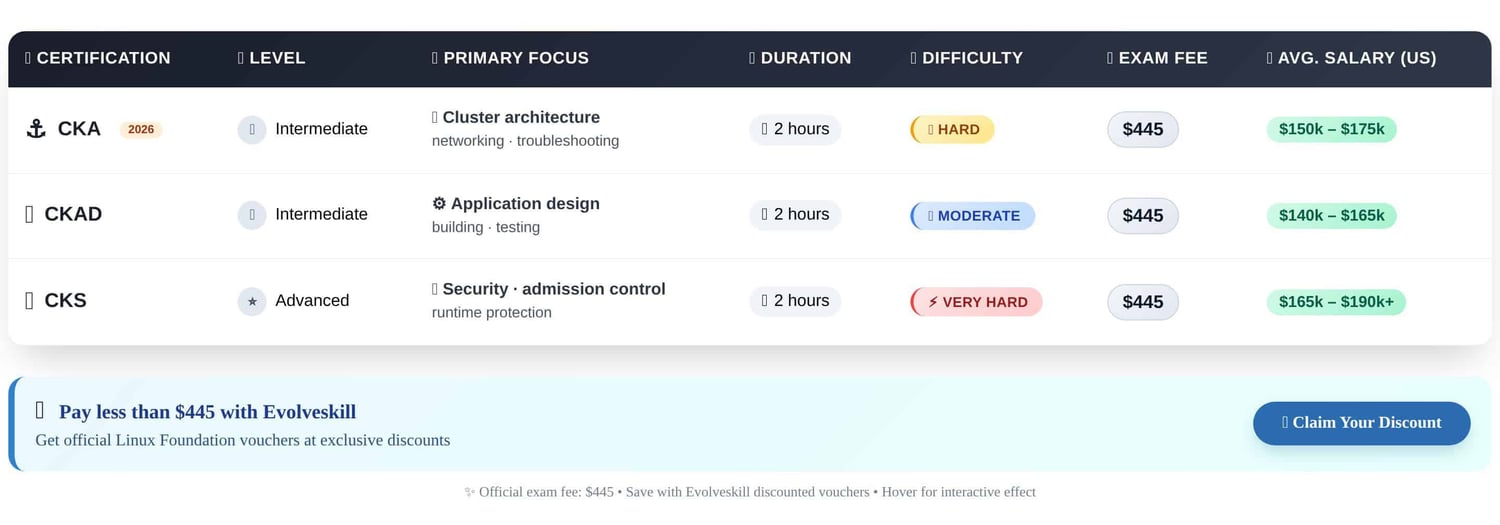
Note: Salary ranges vary by location and experience. These figures represent US-based roles with 3–5 years of experience.
What is CKA (Certified Kubernetes Administrator)?
The CKA certification is the foundation of the Kubernetes ecosystem. It proves you can perform the duties of a Kubernetes administrator—installing clusters, configuring networks, managing storage, and troubleshooting outages.
Skills Covered in Detail
The CKA exam domains break down as follows:
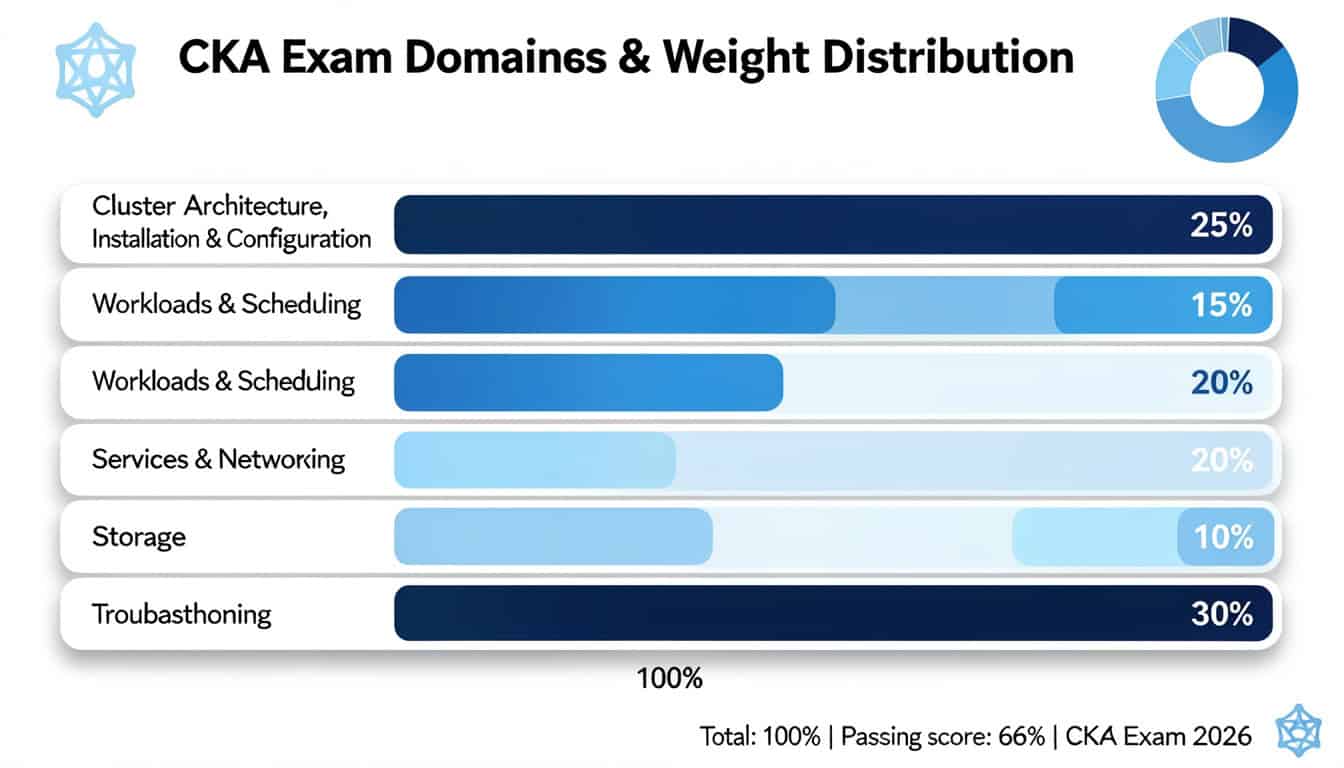
Let me translate what this actually means for your day-to-day work:
Cluster Architecture (25%): You need to know how to bootstrap a cluster from scratch using kubeadm. You should understand control plane components—the API server, etcd, scheduler, and controller manager. If the API server goes down, can you bring it back? If etcd is corrupted, can you restore from a backup?
Workloads & Scheduling (15%): This covers how Pods are scheduled onto nodes. You will deal with taints and tolerations, node affinity, and resource limits. Ever had a Pod stuck in Pending? This section teaches you why.
Services & Networking (20%): Kubernetes networking is where most administrators struggle. You need to understand ClusterIP, NodePort, LoadBalancer, and Ingress controllers. Network policies are also tested—can you lock down traffic between Pods?
Storage (10%): Stateful applications need persistent storage. You will work with PersistentVolumes, PersistentVolumeClaims, and StorageClasses.
Troubleshooting (30%): This is the heaviest section. You get a broken cluster and must fix it. Worker nodes not ready? Fix it. Pods crashing? Find out why. This is where theory meets reality.
Who Should Take It?
If you are a system administrator, DevOps engineer, or cloud infrastructure professional, the CKA is your starting point. You are the person who ensures the cluster stays up when developers deploy buggy code.
Realistic Difficulty Level
The CKA is hard. Not impossible, but hard. The passing score is 66%, and you are working against the clock. Most candidates fail on their first attempt—not because they lack knowledge, but because they run out of time. The exam terminal is slow, the questions are layered, and panic sets in.
If you are aiming for the CKA, you need hands-on labs. Reading books won't save you.
What is CKAD (Certified Kubernetes Application Developer)?
The CKAD certification focuses on the application layer. You are not building clusters; you are deploying applications inside them.
Skills Covered in Detail
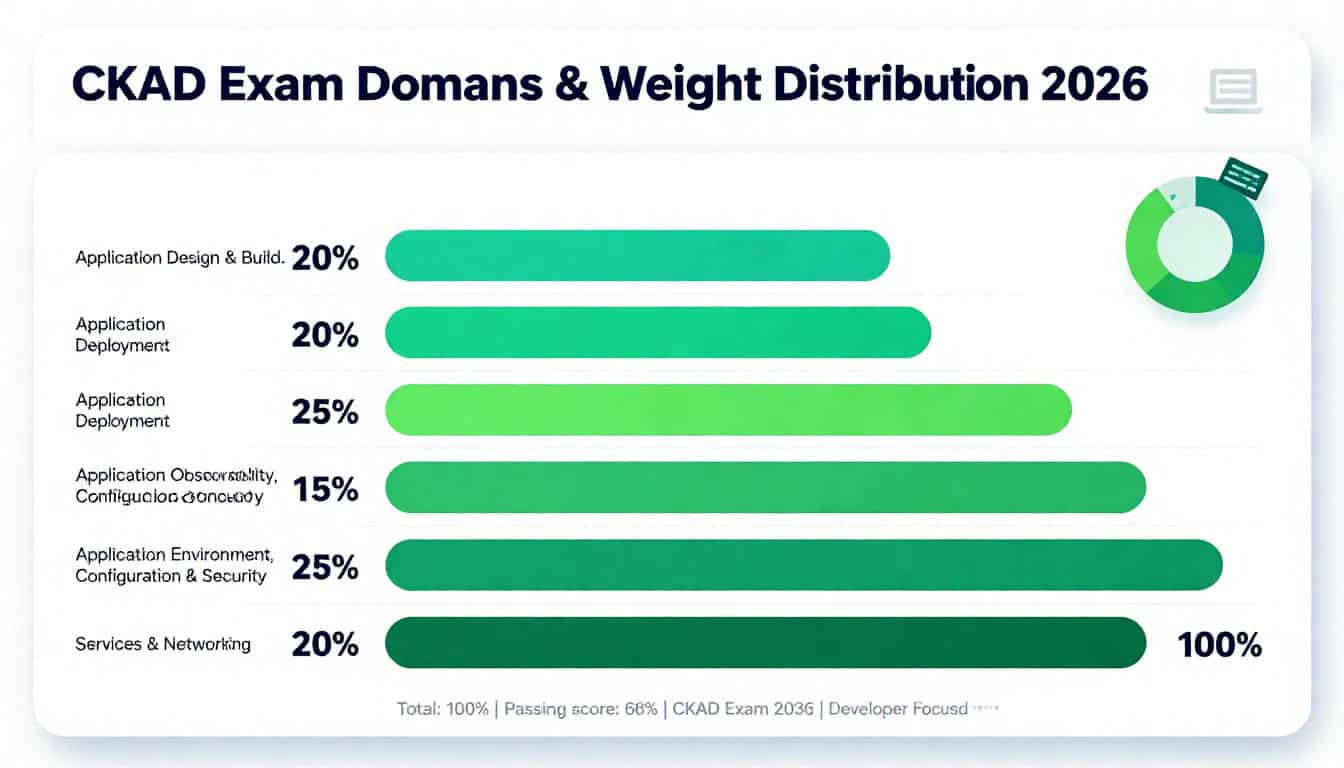
Here is what actually gets tested:
Application Design & Build (20%): You need to define containers, use multi-container Pods (sidecar patterns), and understand init containers. You will work with ConfigMaps and Secrets to inject configuration.
Application Deployment (20%): Rolling updates, rollbacks, and deployment strategies. Can you update an application without downtime? Can you roll back when something breaks?
Application Observability (15%): Probes are critical—liveness, readiness, and startup probes. You also need to understand container logging and how to debug running Pods.
Configuration & Security (25%): This overlaps with CKA, but from a developer perspective. You use Secrets, ServiceAccounts, and security contexts. You are not securing the cluster—you are securing the application inside it.
Services & Networking (20%): Exposing applications via Services and understanding basic network policies.
Focus on Developers
The CKAD is designed for developers who write microservices. You are expected to know how to package your application, deploy it, and make it accessible. You do not need to understand etcd backups or control plane recovery.
Learning Curve
The CKAD is slightly easier than the CKA because the scope is narrower. You do not need to understand the cluster's internals—just how to push workloads into it. However, "easier" is relative. You still need to be comfortable with YAML, kubectl, and imperative commands.
CKAD vs CKA salary? CKAD roles pay slightly less on average because the responsibilities are less "on-call" and more "design-focused." If you hate being woken up at 3 AM, the developer path might suit you better.
What is CKS (Certified Kubernetes Security Specialist)?
The CKS is the final boss. It builds directly on the CKA and focuses exclusively on securing containerized environments.
Advanced Nature
You cannot take the CKS without first passing the CKA. This is a hard prerequisite. The Linux Foundation enforces it because security builds on administration—you cannot secure what you do not understand.
Skills Covered in Detail
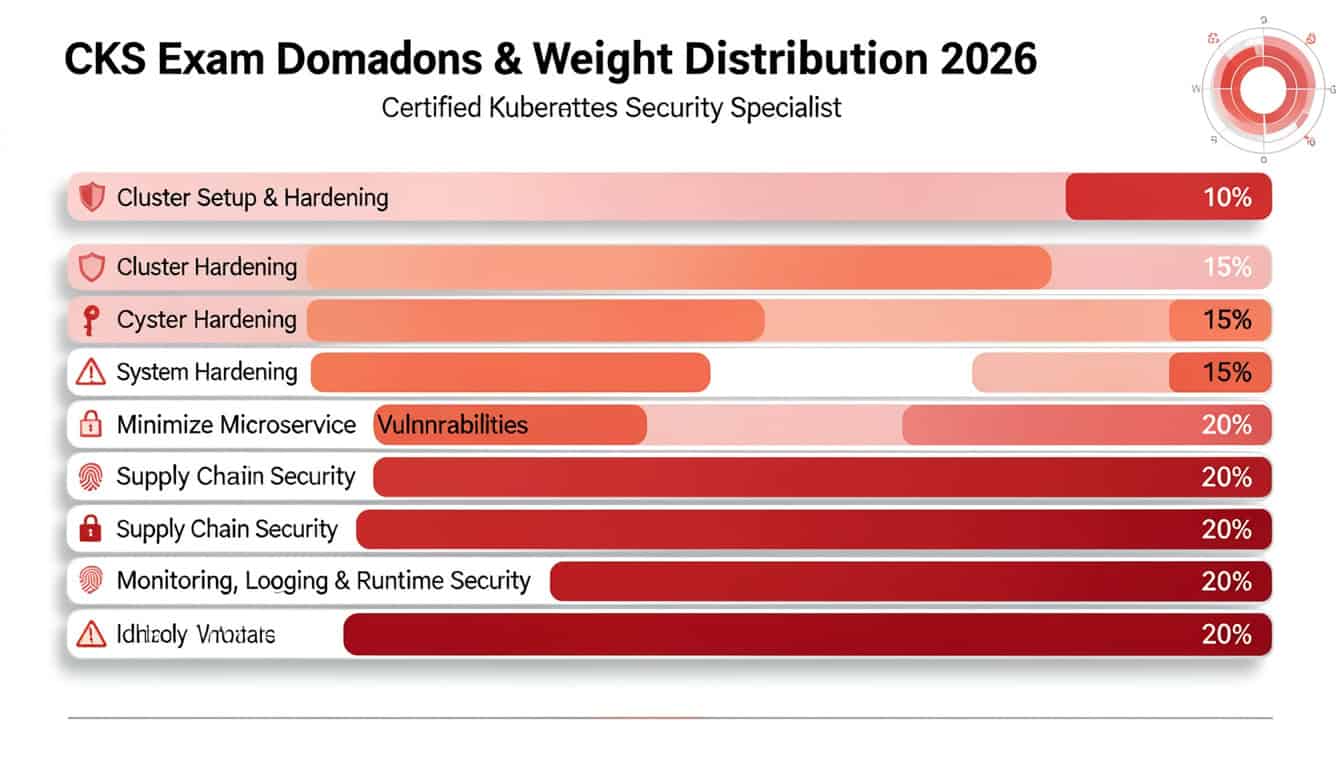
Let's break down what this means in practice:
Cluster Setup & Hardening (10%): Secure ingress, CIS benchmarks, and API server authentication.
Cluster Hardening (15%): Restricting access to etcd, using TLS, and managing certificates.
System Hardening (15%): Minimizing host OS footprint, limiting node access, and using AppArmor/Seccomp profiles.
Minimize Microservice Vulnerabilities (20%): This is where you use admission controllers to enforce security policies. Pod Security Standards (now Pod Security Admission) are critical here.
Supply Chain Security (20%): Image scanning, signing, and ensuring only trusted images run. Tools like Cosign and Notary appear here.
Runtime Security (20%): Detecting threats at runtime using Falco. Behavioral analysis and anomaly detection.
Security Focus
The CKS is not about theory—it is about hardening real clusters. You will configure admission webhooks, write OPA policies, and set up runtime monitoring. If you enjoy breaking things and then locking them down, this is your certification.
Difficulty Level
The CKS is widely considered the toughest of the three. The exam environment is isolated, the questions are complex, and the security tools are constantly evolving. You need to be comfortable with low-level system configurations.
If you want to work in DevSecOps or specialize in Kubernetes security, the CKS certification cost is worth every penny.
Key Differences Between CKA vs CKAD vs CKS
Let's put them side by side in plain English.
- CKA = Cluster Operator. You build it, you fix it, you keep it running. You are the person who gets paged at 2 AM when the cluster goes down.
- CKAD = App Deployer. You write YAML, you deploy code, you make sure the app talks to the database. You rarely touch the control plane.
- CKS = Security Guardian. You lock everything down, block bad containers, and prevent privilege escalation. You are the last line of defense before a breach.
CKA vs CKAD vs CKS is not a competition—it is a progression. Most professionals start with CKA, move to CKAD (or skip it), and eventually pursue CKS for the salary bump.
Prerequisite Relationships
This is critical:
- CKA has no prerequisites. Anyone can take it.
- CKAD has no prerequisites. You can take it without CKA.
- CKS requires a valid CKA certification. You cannot bypass this.
If you want the CKS, plan your roadmap accordingly. Take CKA first, then CKS. CKAD is optional.
Which Certification Should You Choose?
Let's get personal. Your background determines your path.
Beginners (Less than 1 year of Kubernetes experience)
If you are new to Kubernetes, start with CKA. It gives you the broadest foundation. Once you understand how a cluster works, the developer (CKAD) and security (CKS) pieces fall into place naturally. Do not jump into CKAD just because it sounds easier—you will miss critical context.
Realistic timeline: 3–4 months of serious study. Yes, months. This is not a weekend certification.
Developers (Writing code daily)
If your daily job involves writing microservices and you rarely touch infrastructure, CKAD is your sweet spot. It validates what you already do: packaging apps, exposing services, and managing configurations.
You can skip CKA if you never plan to manage clusters. But here is a warning—understanding the cluster makes you a better developer. Consider taking CKA later for the breadth of knowledge.
Security Professionals
If your title contains "Security," CKS is the endgame. But you cannot skip CKA. The security specialist path requires you to understand what you are protecting. You must know how a cluster breaks before you can lock it down.
Warning: CKS assumes you already have production experience. If you are new to Kubernetes, do not attempt CKS first. You will fail.
Career Switchers (From traditional IT)
Switching from traditional IT (VMware, Windows Server, networking) to cloud native? Go CKA. It is the most recognized credential on your resume and opens doors to DevOps roles.
Your sysadmin background helps—you already understand troubleshooting, networking, and system internals. Kubernetes just wraps those concepts in containers.
The "I Want All Three" Path
Some people pursue the full stack. Here is the optimal order:
- CKA – Build your foundation
- CKAD – Add developer skills (optional, but complementary)
- CKS – Specialize in security
This progression takes most people 12–18 months. Do not rush it. Each certification builds on real experience.
Salary and Job Opportunities
Let's talk money—realistically.
CKA Salary and Roles
Typical roles: Platform Engineer, DevOps Engineer, Site Reliability Engineer, Kubernetes Administrator
Salary range: $150,000 – $175,000 (US)
CKA holders are in high demand for platform engineering roles. You are the person who designs the infrastructure that developers love (or hate). Companies need you to build internal developer platforms, manage multi-cluster environments, and keep everything running.
Job market reality: CKA is the most frequently requested Kubernetes certification in job postings. If you only have a budget for one exam, make it this one.
CKAD Salary and Roles
Typical roles: Cloud Native Developer, Microservices Developer, Application Engineer
Salary range: $140,000 – $165,000 (US)
CKAD holders fit perfectly into application teams. You are the "Kubernetes person" who translates business logic into cluster resources. You work closely with CKA holders to ensure your applications run efficiently.
Job market reality: CKAD is valued but often paired with CKA. Many job postings ask for "CKA or CKAD," preferring the administrator credential.
CKS Salary and Roles
Typical roles: DevSecOps Engineer, Kubernetes Security Engineer, Cloud Security Architect
Salary range: $165,000 – $190,000+ (US)
CKS holders are rare. Security is hard, and Kubernetes security is harder. Companies pay a premium for specialists who can pass audits and prevent breaches. If you hold the CKS, you are in the top tier of Kubernetes professionals.
Job market reality: CKS is a differentiator. In a sea of CKA holders, CKS makes you stand out. Security budgets are also less likely to be cut during economic downturns.
Geographic Variations
- United States: Salaries listed above apply. Tech hubs (Bay Area, NYC, Seattle) pay 20–30% more.
- Europe: Salaries are lower but still strong. £70,000–£90,000 in the UK, €80,000–€100,000 in Germany.
- Remote work: All three certifications enable remote roles. US companies hire globally for Kubernetes talent.
Exam Cost + Voucher Options
Let's talk numbers—because certifications are an investment.
Official Pricing
- CKA Exam: $445 (includes one free retake)
- CKAD Exam: $445 (includes one free retake)
- CKS Exam: $445 (includes one free retake)
These prices are non-negotiable directly through The Linux Foundation. However, you can reduce your costs significantly by purchasing discounted vouchers through authorized resellers.
The Free Retake Explained
Each exam comes with one free retake if you fail. Here is how it works:
- You schedule your first attempt.
- If you pass, congratulations—you are certified.
- If you fail, you get a second attempt within 12 months at no additional cost.
This safety net is huge. Treat the first attempt as a dress rehearsal. The exam environment is stressful, and the free retake takes the pressure off.
How to Pass CKA, CKAD, and CKS (Actionable Strategy)
You bought the voucher. Now you need to pass. Here is what actually works.
1. Labs, Labs, Labs
You cannot pass these exams by reading. You need a terminal.
Free options:
- Minikube locally
- Kind (Kubernetes in Docker)
- Play with Kubernetes (online sandbox)
Paid options:
- Killer.sh (included with your voucher—use it!)
- KodeKloud labs
- Udemy practice tests
Aim for at least 50–60 hours of hands-on practice before your first attempt. Yes, hours. Typing commands builds muscle memory.
2. Master the Imperative Commands
Typing YAML from scratch wastes time. Learn kubectl run --image with all the flags. Generate Pod YAML with --dry-run=client -o yaml. Speed is the difference between passing and failing.
Example:
# Create a deployment with 3 replicas
kubectl create deployment nginx --image=nginx --replicas=3 --dry-run=client -o yaml > deployment.yaml
# Edit and apply
vim deployment.yaml
kubectl apply -f deployment.yaml
This workflow saves 5–10 minutes per question.
3. Time Management
The CKA and CKS give you about 3–4 minutes per question. If you are stuck for 10 minutes, bookmark the question and move on. You can come back.
Strategy:
- Scan all questions first
- Answer easy ones quickly
- Bookmark hard ones
- Use the remaining time on bookmarked questions
4. Use the Documentation
The official Kubernetes docs are allowed. Bookmark the pages you need before the exam. Practice finding things fast.
Key bookmarks:
- kubectl cheat sheet
- API reference for common resources
- Tasks section (e.g., "Configure Liveness Probe")
5. Take the Free Retake Seriously
Everyone gets one free retake. Treat the first attempt as a dress rehearsal. If you pass—great. If you fail, you know exactly what to study next.
Post-exam analysis:
- What domains felt weak?
- Which questions took too long?
- Did you panic during certain tasks?
Use this data to focus your second attempt.
6. Specialize Your Study
For CKA:
- Focus on etcd backup/restore (this is almost guaranteed to appear)
- Practice troubleshooting node failures
- Understand network policies deeply
- Master kubectl debugging commands (kubectl describe, kubectl logs, kubectl exec)
For CKAD:
- Practice rolling updates and rollbacks
- Get comfortable with probes (liveness, readiness, startup)
- Understand ConfigMap and Secret mounts
- Practice multi-container Pod patterns (sidecar, adapter, ambassador)
For CKS:
- Install and configure Falco (runtime security)
- Write OPA policies (admission control)
- Practice image scanning with trivy
- Understand AppArmor and Seccomp profiles
- Secure etcd and API server
7. Recommended Resources
Courses:
- Mumshad Mannambeth's courses on Udemy/KodeKloud (gold standard)
- Linux Foundation official training (expensive but comprehensive)
- Killer.sh simulator (included with voucher—use it twice)
Books:
- "Kubernetes Up and Running" (O'Reilly)
- "Certified Kubernetes Administrator (CKA) Study Guide" (Benjamin Muschko)
Practice Exams:
- Killer.sh (harder than the real exam—good preparation)
- Udemy practice tests (Mumshad's are excellent)
Common Mistakes to Avoid
Mistake 1: Skipping Hands-On Practice
Reading books and watching videos may feel productive, but they are not. You need to type commands. The exam terminal does not have autocomplete help. Your fingers need to know the commands.
Mistake 2: Ignoring the Documentation
Some candidates try to memorize everything. Do not. The docs are allowed. Know how to navigate them quickly.
Mistake 3: Poor Time Management
The hardest questions are worth the same points as easy ones. Do not spend 20 minutes on one question. Move on, come back later.
Mistake 4: Not Reading Questions Carefully
Each question describes a broken state. Read twice. Understand what they want. Sometimes the fix is simple—a missing label or a typo in a YAML file.
Mistake 5: Underestimating Exam Environment
The remote proctoring is strict. You cannot look away from the screen. You cannot talk to yourself. Practice in a quiet room with no distractions.
Frequently Asked Questions
Is CKA harder than CKAD?
Yes, generally. CKA covers more topics (including cluster management and troubleshooting) and is perceived as more difficult. CKAD is narrower and focuses on application deployment.
Can I take CKS without CKA?
No. CKS requires a valid CKA certification. This is enforced by The Linux Foundation.
Which certification pays the most?
CKS typically pays the highest due to its specialized nature and the prerequisite CKA requirement. Security specialists command premium salaries.
How long are these certifications valid?
All three certifications are valid for 3 years from the date of passing. You must recertify before expiration to maintain active status.
Can I take the exam from home?
Yes. All exams are remotely proctored. You need a quiet room, a webcam, and a stable internet connection. The proctor monitors you through the webcam.
What happens if I fail?
You get one free retake included in your voucher. Schedule your second attempt within 12 months. Use the time to study your weak areas.
Do I need to know Docker?
Yes and no. You need to understand container concepts, but the exams focus on Kubernetes rather than Docker specifically. However, knowing Docker helps with image concepts and debugging.
Are there any age or education requirements?
No. These certifications are open to anyone. No degree required.
Final Verdict (Brutally Honest)
Here is the truth about CKA vs CKAD vs CKS:
- CKA is the most valuable certification overall. It proves you can run Kubernetes in production. If you only get one, get this one. It opens the most doors and builds the strongest foundation.
- CKAD is the best for developers who want to stay in the application layer. It is respected but narrower in scope. Pair it with CKA for maximum impact.
- CKS is the advanced niche certification for security specialists. It pays well, but it is hard and requires CKA first. If security is your passion, this is the endgame.
Your Roadmap
If you are new: Start with CKA. Study for 3–4 months, practice daily, and take the exam. Then decide on CKAD or CKS based on your career goals.
If you are a developer: CKAD first, then consider CKA later. Understanding the cluster makes you a better developer.
If you are in security: CKA first, then CKS. Do not skip the foundation.
The ROI Question
Are these certifications worth it?
Yes—if you combine them with experience. The certification alone does not guarantee a job. But the knowledge you gain while studying does. These exams force you to learn Kubernetes deeply. That depth translates directly to on-the-job competence.
Most certified professionals recoup the cost of the exam within weeks through salary increases or new job opportunities. The ROI is real.
Your Next Step
If you are still unsure, start with CKA. It is the trunk of the tree; CKAD and CKS are branches. You can always add them later.
And when you are ready to book, remember: you do not have to pay full price. Visit Evolveskill for the best Linux Foundation exam voucher deals available online. We have helped thousands of professionals certify for less—and we would love to help you too.
Still have questions? Drop them in the comments below. We read everyone. And if you found this guide helpful, share it with someone else who is stuck in the CKA vs CKAD vs CKS maze.
Related Resource
Disclaimer: Salary figures are estimates based on industry surveys and job postings. Actual compensation varies by location, experience, and company. Exam content and pricing are subject to change by The Linux Foundation.